"I will never kick a rock"

Monthly archive

October 2020

Geology on the Glasco Pike

in Uncategorized by

Down the Pike

On the Rocks, The Woodstock Times

Sept. 17, 1998

Updated by Robert and Johanna Titus


Sometimes it’s well to pause and take stock of things. If you have been reading these columns the past two years, then you have been introduced to a rather eclectic view of the Woodstock area landscape, our landscape as a geologist sees it. The column is meant to be as much for fun as for education, so we have not tried to be too serious, or too focused. The column is not a formal course in geology, and you won’t get college credits for it. Still, this week, why don’t we try to draw together some of the many strings we have been following. There’s a nice afternoon trip that can do just that too.

The road we have in mind is a venerable one, it’s County Rt. 32, but it’s better known as the Glasco Turnpike, and it cuts through a lot of geology. Pick up the pike at its intersection with Rte. 9W, at Glenerie. All along the east side of 9W you will see the Helderberg Limestone. This represents Woodstock in the early Devonian Period, about 400 million years ago. The limestone formed on the floor of a shallow tropical sea. There’s good fossil hunting here, shellfish that lived upon the soft sands and inhabited the clear waters of an aqua colored “Bahamas

Woodstock, however, has not always been such a nice a place as it was during Helderberg times. Cross the bridge at Glenerie and head west on the pike. You will pass a great outcrop of black shales. We have traveled in space, but more importantly, we have traveled in time. This is Woodstock at a younger and very non-Bahamian time. Off to the east the Acadian Mountains were rising. Curiously, as mountains rose in New England, here crustal subsidence created a deep basin. When we visit those shales, we enter that basin: A deep, dark, mud-bottomed sea that replaced the Helderberg. There was nothing very pretty about this moment in Woodstock’s past. In fact, this ocean could be downright ugly. It was definitely inhospitable, a deep and dark, and sometimes even poisonous sea where few creatures could endure.

Continue west on the pike, cross the Kings Highway, and then the Thruway. About a half mile down the road you will reach Plattekill Creek. To the left, a very impressive cliff towers above the road and the creek. That’s the Mt. Marion Formation. It represents the last stages of that deep, mud-bottomed sea. The shales can be good fossil hunting, if you are patient. Horn corals and other fossils have been found here. Near the top of the exposure you will notice that there are thick ledges of gray sandstone. That’s important; the seas were at last shallowing and strong coastal currents were carrying masses of sand to the Woodstock area.
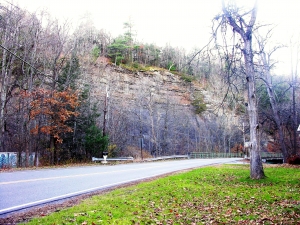
As the Acadian Mountains continued to rise in New England, the seas here once again shallowed and the coastline advanced westward. We call that a marine regression. Let’s see the results. Drive uphill from Plattekill Creek. Soon you will start passing very thick ledges of gray sandstone. There is a pattern to the road from here on to the west as far as you care to go. The pike will commonly rise up over a ledge of sandstone and then dip down into a swale beyond. Soon another ledge appears and the road rises again, only to drop down still one more time. And so on it goes down the road. Each sandstone ledge is the cross section of a Devonian river. Each swale is composed of dark, soft shales; they were deposited in coastal lagoons or on marshy coastal flood plains. Our regression has brought us out of that deep ocean basin and into the coast of a great delta complex.

The delta has a name, the Catskill Delta, and you pass into the heart of it as you cross Rt. 212 and continue west on the pike. Along the side of the road you will see more thick river sandstone ledges, much like those behind us, but now there are also many red shales. Red is a common color among terrestrial sediments, and these are the deposits of the flood plains across which the rivers flowed. There were once forests on these flood plains. And also, the Acadian Mountains towered above, perhaps as high as today’s Himalayas.

Our trip it over, but it has taken us mountains of nearly 400 million years ago through a lot of geologic history and it has given me a chance to organize a number of themes that I have written about these last two years. I hope you can get a chance to follow the Glasco Turnpike, see its history, and maybe begin to really understand the Acadian Mountain building event. After all, the Acadian Mountain building event pretty much made Woodstock.

   Contact the authors atrandjtitus@prodigy.net. Join their facebook page “The Catskill Geologist.”
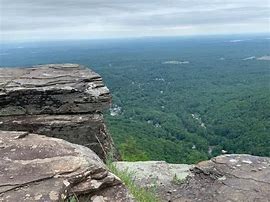
Overlook’s overlook 10-22-20

in Uncategorized by

An Overlook that’s Overlook’s Overlooked Twin

On the Rocks

Nov. 5, 1998

Updated by Robert and Johanna Titus


As you drive up Rte. 23A and approach Kaaterskill Clove you can look upwards and see two great sandstone cliffs, way up toward the top of South Mountain. The higher of the two is known as the Palenville Overlook. It’s an out of the way site with a lot of geological history.

The Overlook is not hard to get to, but you do have to know the way. Start at the parking lot at North Lake and head due east toward the escarpment. You will find a marked snowmobile/horse trail there. It used to be the historic mountain road that brought carriages to the old Catskill Mountain House Hotel. Follow it downhill which takes you north, then watch for a right branch and take it. There’s a sign pointing toward the overlook. You will then be heading back to the south and you will soon cross the gash in the forest where the Otis Elevated Railroad once passed. Keep going south on the trail for a half hour or so until you reach a left fork. That fork continues to take you south and, in another ten minutes or so, you have arrived at the Palenville Overlook. It’s best to bring a map.

You won’t have any trouble knowing that you have gotten there. It’s a grand location; below yawns Kaaterskill Clove at its widest and deepest. Immediately to the west is another ledge called “Point of Rocks.” We haven’t been there yet but it appears to be a Palenville Overlook twin. Beyond the twin is all of Kaaterskill Clove itself. The Overlook is a place worth visiting at different times of the day and different seasons of the year. On many mornings there is fog in the valley below. As the day progresses the fog lifts and the great view emerges. Golden, in this autumn season, it will soon turn gray and then, as the cycle of the seasons continues, light and dark greens follow.

  The Palenville overlook

To the east is the expanse of the Hudson Valley. A geologist can’t help but to imagine the past when he looks into the valley. The great flat width of the valley floor below was the site of glacial Lake Albany at the end of the ice age, maybe 14 or 15 thousand years ago. It’s also easy to imagine the large valley glacier that was once down there as well.

Like any good geologists, we wondered how the ledge got there. The first hint that we found was along the horse trail. Not surprisingly, there are some stretches of the path that cut across bare bedrock. Some of that bedrock had been scraped, ground down and polished by the passage of a glacier, maybe 20,000 years ago. The grinding passage of the ice carved striations into the bedrock and these have a north-to-south orientation; the glacier had headed this way long before we got there.

That’s pretty much all we had to know to figure out what had made the Palenville Overlook. That glacier was probably part of what is known as the Wisconsin ice sheet. As early as 22,000 years ago the ice had completely submerged South Mountain and was advancing southward across it. When a glacier reaches a cliff, it very often breaks loose large blocks of rock. We call that process “plucking.” Not that anyone has ever seen plucking; it’s something that only happens at the bottom of the ice, but we can imagine what went on down there. There may have been a couple of thousand feet of ice here back then, and the weight of all that ice pressed down heavily upon the bedrock. That’s how the grinding, polishing and striations came about, and it probably also has a lot to do with the plucking. It seems that the thick ice presses onto and adheres to the bedrock. Then, as the ice moves on to the south, it literally yanks loose large blocks and drags them off. What is left behind is a jagged scar, the plucked cliff.

Plucked cliffs are very common throughout glaciated mountainous areas. There are a large number of them in the Catskills. Here in Woodstock, you can climb Overlook Mountain and see a good plucked cliff at the top of Lewis Hollow. That’s the cliff right in front of the old hotel ruins. The very same glacier that overrode Palenville also passed across Overlook and left the same features behind.

It’s autumn in the Catskills. You should never let this season go by without getting out. Palenville Overlook is just the sort of hiking goal that makes the season the grandest of the year.

Contact the authors at randjtitus@prodigy.net. Join their facebook page “thecatskillgeologist.com.

Crack me up Oct 15, 2020

in Uncategorized by

Crack Me Up

On the Rocks – The Woodstock Times

1998

Updated by Robert and Johanna Titus


Middle and late summer often brings the dry season of the year to the Catskills. The streams run dry or nearly so. The cobbles and boulders become light with a coating of dry and bleached algae. Nervous fish circle in the remaining pools of unhealthy, stagnant water. Along the stream banks, dry weeds have a lifeless look to them. If the plants are thirsty, then it’s at least partly their own fault: They have drawn so much water out of the ground.

It’s not a pleasant time of the year for those plants and animals that depend on lots of water and it never has been. Our August cycle is just this year’s edition of something that always has been, and probably always will be. It’s hot in August and when it’s hot things dry out. If we said that it was like this back in the Devonian time period when the Catskills were a great delta complex, we think that you might believe us. But if we said that you can go and still see some of the damage done during Devonian droughts, we would expect at least some skepticism. And yet it is so.

Sedimentary rocks, take sandstones for instance, are records of conditions as they were when the sediments were being deposited. Our Catskill sandstones were deposited in a multitude of delta environments, but one thing was certain. When there were droughts, pretty nearly the whole delta dried out. And that is reflected in the sedimentary rocks.

Sediment is generally deposited in some sort of watery environments. Catskill sediments were deposited in streams, ponds, pools, marshes and all sorts of watery settings. So, they were very nearly always wet upon deposition. But that didn’t mean that they would stay wet. Back in the Devonian there were dry seasons and dry years. Ponds and pools evaporated, shrank and dried up. Even rivers could run dry in the worst cases. Similarly soils and sediments dried up as well, although we geologists like to say they “desiccated.” At any rate, the last thing to happen was that the still wet muds at the bottom of any body of water were exposed to the sun and began to dry out. The clays within them would begin to shrink and so too would the whole mass of sediment.

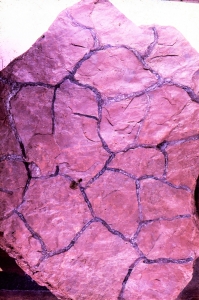
Mud does not just dry out; it begins to divide into many small individual masses. Each of these continues to dry out and shrink towards it’s own center. The result is a maze of interlocking polygonal blocks. We call these “mud cracks.”

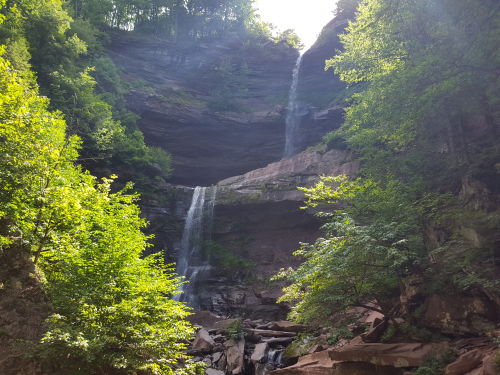
All this kind of explanation works better if you can go outside and see some of these features. Drive up to Kaaterskill Clove and find a place to park near the clove’s first legal parking. Then hike up to a fine waterfall, Fawn’s Leap. There is a bridge below the falls and below that bridge you will find a prominent ledge of very red sandstone. Climb down and look carefully. It shouldn’t be long before you see some green mud crack polygons, standing in sharp contrast to the red sandstones. That’s them.

It’s very kind of nature to give us those color contrasts, but there is nothing magical about it. Mud cracks tend to fill with quartz sand while the surrounding muds were rich in certain clay minerals. These clays tend to oxidize in the presence of air and that turns them red. The mud cracks, being of a different mineralogy and maybe being a little more waterlogged, don’t turn red, they turn green. Presto! Sharp contrast.

A mud cracked surface can be a lot of fun to crawl around on and study carefully. You can sometimes find insect tracks or bits of plant fossils. Raindrops prints are found where the rocks record a brief shower that interrupted the drought. Once I found a complete fish skeleton. The poor animal had died as its pond slowly dried up. As I said these are bad times for plants and animals. That’s the wonder of it; the rocks are records of the past. They speak to us of awful, killing droughts of long ago. Animals suffered in the heat and died painful deaths alone in the dust or dried out pools. But that was back in the Devonian and nobody cared, nobody mourned, nobody pitied. And, in the end, only the rocks remember.

Contact the authors at randjtitus@prodigy.net. Join their facebook page “The Catskill Geologist.”

Visiting North Lake

in Uncategorized by

Feeling out of place at North Lake

Windows Through time, The Register Star – May 20, 2010

Updated by Robert and Johanna Titus


We are all very fortunate to have a place such as the North-South State Campground in our region. It has been a very popular draw for visitors since the early 19th Century and for good reason. It must be one of the most picturesque landscapes east of the Mississippi. The park sits atop the Catskill Front, overlooking a 70 mile stretch of the Hudson Valley with many breathtaking views.

There is a lot of geology to be seen in the park, so you have to make up your minds on what to do. You will want to walk around North Lake at, we hope, a leisurely pace. The walk will start at the Mountain House site parking lot and head north until you circle around most of North Lake and then return.

So, what is the geological “bait?” Well, mostly it is the Ice Age history of North Lake that you will want to explore. Both North and South Lake basins were scoured out by the glaciers, probably at the very peak of the Ice Age. Glaciers filled the Hudson Valley and then rose up and streamed into the area. You will want to walk along the eastern shore of North Lake and take a good look at the bedrock evidence of this. This rock records the passage of the ice. It’s actually been ground down and polished by the advancing glaciers. But the most striking features along the lakeshore are the striations carved into the rock. The glaciers dragged rocks along with them, and these gouged the rock. It’s a lot of fun to spot these and take note of them.  Each striation has the very same compass direction as the movement of the ice. Each is thus a history of Ice Age activity at North Lake.

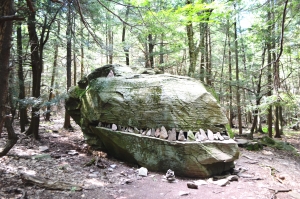
But what we like even better than the striations are the Ice Age features that are called “erratics.” These are boulders, often very large, which were carried here by the moving ice. Glaciers are quite capable of lifting very large rocks and sweeping them along. We have been finding erratics here in abundance. Some of them are famous; maybe you have seen the one called Alligator Rock.  It, in fact, does look like the head of an alligator. It even has a large open “mouth.” People have been putting stone teeth in that mouth for as long as they have been coming here.


Dinosaur Rock

This great rock, and probably scores of others, dot the landscapes at North Lake. We think the largest number of them are found on the point that separates North and South Lakes. But there are many more, all around the lakes. What are they and where did they come from?  Well, the history of any erratic begins when ice was passing across its home bedrock. The ice tended to stick to that rock and, as the glacier advanced, it plucked the boulders loose and dragged them off. That’s what’s erratic about these rocks; they don’t match the local bedrock. The glaciers eventually melted and when they did, they left those erratics behind, right where we see them

today.

There’s more to the story.  Erratics are clustered in the North Lake vicinity,

suggesting they all came from the same glacier. When you get to North Lake, you

should look up to North Point and see where that glacier came from. Near the top of

North Point there is great basin, just below the peak. Geologists will recognize this as

what is called a cirque. Cirques are the basins in which Alpine glaciers had formed and

from which they began their downhill journeys. We will look up at that cirque and in our

mind’s eyes we will see an Alpine glacier. We will watch as it slowly descended the

slopes of Mary’s Glen, heading toward North Lake. We won’t be able to see them, but

that glacier was ripping up our erratic boulders and carrying them along for the ride. We

will watch long enough to see the climate warm and the ice melt. It is then that those

boulders will be left behind

Contact the authors at randjtitus@prodigy.net. Join their facebook page “The Catskill

Geologist.”

Dinosaur Rock

Memories come flooding back – Oct. 1, 2020

in Uncategorized by

Memories Come Flooding Back

On the Rocks/ The Woodstock Times

July 2, 1998

Updated by Robert and Johanna Titus 


A little east of the town of Delhi we found a ledge of Devonian aged river sandstone which had been a deep channel cut into a now fossil soil horizon. This sort of thing is hardly rare in the Catskills, there are, for example, many such fossil rivers in the hills above Woodstock, but this was a very good one, however, and it made us ponder the history that such ledges represent: There was a story here.

March 14th, the year 387,469,184 BC, late afternoon.– All day long, very moist air has been rising up the slopes of the Acadian Mountains to the east, and now dark banks of storm clouds tower above the tall mountain peaks. Soon three closely spaced lines of thunderstorms unload, in quick succession, upon the mountains. The rain of the first line of storms quickly waterlogged the soils and the subsequent torrents have raced off downhill in deep, fast-flowing, erosive streams. Deep gullies have been rapidly cut into the soft, blue-black earths of the upper mountain slopes. A thick ooze of dirty water (in fact, almost watery dirt) has funneled into gullies too numerous to count. Down slope, those gullies combine into several powerful cascading streams; deep channels are being widened rapidly. More dark earth is engulfed by the expanding flow, and whole slopes slide into the torrent. The rush of the confined water is being pushed and hurried along by the great torrents backed up behind.

From various compass points, similar flows combine to a point well down on the face of the Acadians. Here, today’s cascade, and many earlier ones like it, have combined to carve a great, vee-shaped cleft in the mountain range. This gap dwarfs the canyons above it. Through this cleft, on this day, flow several large Niagaras; this is a catastrophic event, a thousand year flood.

Below the narrows, the Acadian slopes level out. Vast piles of coarse sand and gravel have formed an enormous, rounded apron of sediment, draped against the slopes of the range. As it flows across this slope, the water breaks up into a number of smaller streams, which continue several miles down the gentle slope until the streams enter a broad plain, a flat morass of flooded bayous, marshes and ponds.

The morass we speak of makes up the great Catskill Delta. Now, its various glutted and disorganized channels reflect the brunt of the flood; their powerful flows cut into adjacent flood plains and carve new channels. Their banks give way and, along with whole stands of trees, collapse into the flow. The channels are soon clogged and dammed with mud and broken trees. The dammed, blue-black waters rise up and flood out across the delta plain.

Flash floods like this are violent but they don’t last long. At the bottom of the now-submerged stream channels, the flood currents eventually slow down and the sediments begin to be deposited as dark horizons of muddy sand. Many plants and animals are being buried within these sands.

As the evening advances, the main flow continues down the channels of the delta. Downstream, the flow is still rapid, but it is beginning to ebb. At the mouths of the rivers, the flood waters, dark with sand and silt, are being disgorged into the western Catskill Sea. From above, large plumes of dirty water can be seen slowly expanding out into the sea. Many tree trunks and a flotsam of broken foliage drift seaward, half hidden in the darkening skies.

By midnight the storms have long been over. The sky is clear and the stars shine, competing with a wine-colored moon. The upper slopes of the Acadian Mountains are now dark, silent silhouettes. Downstream, the churning flows of the day are still rapid and gurgling with noise, but the normal languid flow of the delta will soon return. The rivers are still dirty, but they are clearing. Offshore the plumes of sediment are settling into thick strata of sticky sand. A large number of shellfish are dying in that burial. Their shells will lie, buried as fossils, for 400 million years.

It has been a very hard day for the biota of the Catskill Delta. But nobody cares. The world of the Devonian is a soul-less one; there is no mourning, no grief, no pity or even self pity. Indeed, there is no real understanding of exactly what happened today, and by midnight, there are few living creatures who can even remember these terrible events.

   Contact the authors at randjtitus@prodigy.net. Join their facebook page “The Catskill Geologist.”

Go to Top