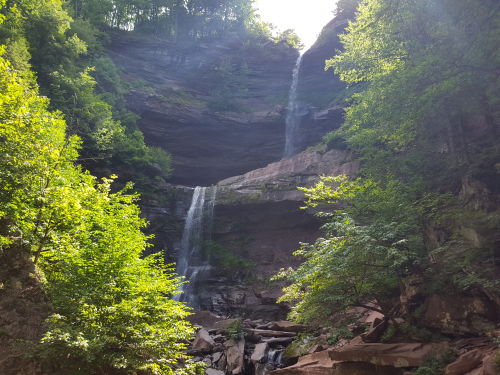
The vastness of time – Part 1: The Catskill Limestones
The Catskill Geologists; The Mountain Eagle; Feb. 12, 2020
Robert and Johanna Titus
To be a geologist is to live on a tiny island in a vast sea of time. Earth history extends backwards a full 4 1/2 billion years. The future of our planet will be equally long. Our three score and ten is so small compared to all that. But a fair question is: how do we know that? The best answers are provided by geochemists who can make these determinations from the study of various chemical isotopes found within some rocks. That’s hard science but it does not make for a very good read. We would like to take a different approach to this question and, at the same time, a far more spiritual one.
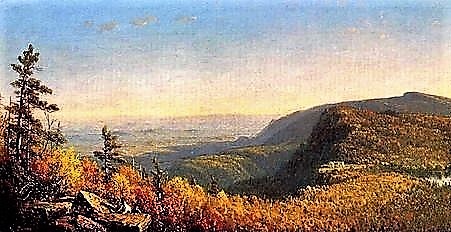
Have you ever been to Thacher Park? It lies at the edge of the Helderberg Escarpment and overlooks a distant Albany. It’s a picturesque location, a massive cliff rising above the Hudson Valley. The Helderberg Escarpment is composed of the Devonian aged Helderberg Limestone, rocks almost 420 million years old. It’s a very important unit of rock. It’s hundreds of feet thick and extends westward far past Syracuse. It makes up a great ledge that runs down the Hudson Valley as well. In fact, it’s our recollection that this limestone is spread out across most of eastern North America. That’s a big unit of rock. What’s the story behind this story?
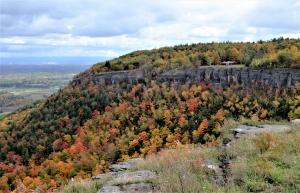 Thacher Park
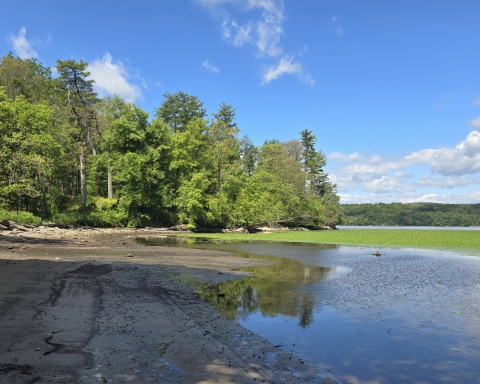
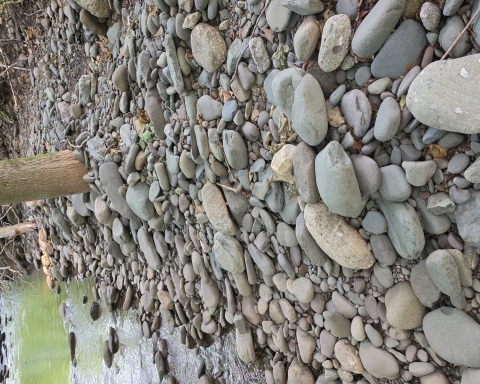
Well limestones, in fact, conjure up quite a tale. Each of them formed in a shallow tropical sea which had been floored with limey sediments. But what exactly is limestone? Take a look at our second photo; it shows a view of a microscopically thin sheet of a typical fossiliferous limestone. The dark particles are fossils, fragments of ancient shellfish skeletons. Those had been mostly shells that came to be broken up and rounded in active seafloor currents. They are composed of the mineral calcite, CaCO3, the very stuff of limestone. The clear white material in between those fossils is pure crystalline calcite cement.
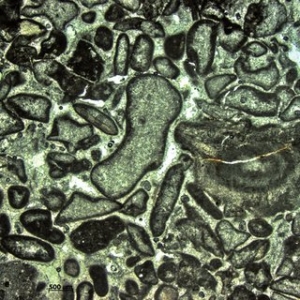
This is a typical limestone lithology and it speaks of great lengths of time. How long did it take for all those generations of shellfish to live and die? How long did it take for chemistry to produce all that cement? The answers to both questions speak of enormous lengths of time. It gets worse. As we have seen, that Helderberg Sea was huge, being spread out across so much of north America. How long did that take to form? Again, the answer to the question forces us to contemplate what seems to be endless eons.
The spiritual part comes along when we let ourselves waft back through time to visit Thacher Park during that early Devonian time period. Suddenly we find ourselves drifting across the shallow Helderberg Sea. Below us we see reef building animals called stromatoporoids, animals now long extinct. We rise up a bit into the air. We are the mind’s eyes and we can do that. Below us we now see the dark shadows of those reefs. All around them are the pink limy sands that will someday be limestones. They are dotted with living shellfish. Here and there we see green patches of algae, plant like creatures that flourished in those sunlit waters. We rise up still higher and higher. Now we are thousands of feet up; soon it will be miles, many of them. The full expanse of the Catskill Sea is opening up before us. It is an aqua colored sea spread out across the vastness of a now global geography. It looks like something that has always been there; it looks like something that will always be there. Looks are deceiving.
Contact the authors at randjtitus@prodigy.net. Join their facebook page “The Catskill Geologist.” Read their blogs at thecatskillgeologist.com.