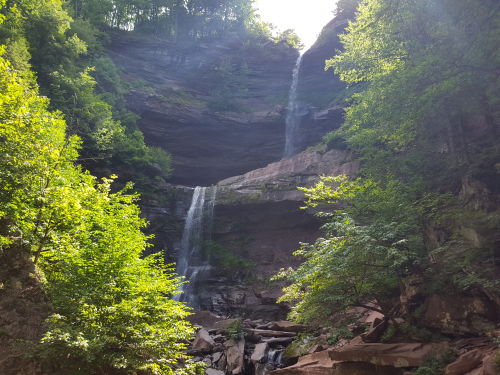
"I will never kick a rock"

Monthly archive

June 2022

What is a limestone? Pt. 1 – June 30, 2022

in Uncategorized by

What is a limestone? Pt 1

Windows Through Time; The Register Star

Updated by Robert and Johanna Titus


Like most people, you have very likely heard the word “limestone.” We use the word frequently in our columns. But do you really know what a limestone is? If you saw one, could you identify it? If not, then let’s go to work and fix that. Let’s learn about one type: a “fossiliferous limestone.”

Limestone is one of the most commonly found types of stratified rock. Stratified means that the rock is layered; it is composed of strata. When you look carefully at a limestone, you are likely looking at a slab of the rock. That slab was originally part of a single stratum. The rock broke up along the surfaces of that stratum to become a loose chunk of rock. When you are looking at such a limestone you are likely looking at the surface of that stratum. And, you are, therefore, looking at a small bit of an actual ancient sea floor. This stratum had been deposited as a sheet of shelly sediment on the bottom of that ocean. That sediment was composed of a large number of shells and shell fragments. These, of course, are now fossils. The sediment in between those fossils is likely to be largely composed of smaller shell fragments. Many of those had been ground down into sediment. That sediment can be sand sized stuff, or even finer. Each grain of sand was once part of a shell. You can’t recognize that anymore, but that is still how it got its start.
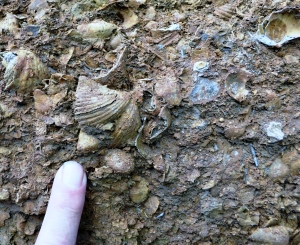


That stratum was deposited and then, later, it was buried under more and then even more strata. The limestone sediment piled up and the weight of it helped begin the processes that would harden it into rock. So, any slab of fossiliferous limestone has quite a past. It had once been a soft sediment, lying on the floor of an ocean, but all that has passed; now it is a rock.   A very large percent of this rock was once shell material. It could be 100 % but it has to be about 60 to 70% or the rock does not qualify as a limestone.

So, identifying a fossiliferous limestone should be simple. And most of the time it is. Take a look at our photo. It’s a close-up of what is called the Glenerie Limestone. (Yes, it is from the village of Glenerie.) It is a Devonian aged limestone, like so many of them around here. The images that leap out of the photograph are the fossils. The one on the left center is a brachiopod, a bivalved invertebrate animal. It’s called a bivalve because it has two shells. That’s just like a clam, but this is not a clam; it is an entirely different creature.

This brachiopod is a full specimen; all parts of both shells are present. It was never broken up.
This specimen is surrounded by fragments of other shells, most of which had also been brachiopods. This rock is an excellent example because, if you could see the original, you would see progressively smaller and smaller shell fragments. It is easy to guess that every particle in this rock was once part of a shell. And that, in fact, is the case. This is a classic fossiliferous limestone. We look again and we realize that we are looking at a small stretch of a Devonian sea floor.

But, can we say more about that ancient sea floor? We sure can, Geologists like to study the modern world. There is so much out there that can help us understand the past. We like to go out and find locations where such limestones are forming today. We have been doing so for centuries and we always find the same thing. Fossiliferous limestones always form on the bottoms of shallow tropical seas. The Bahamas are a terrific example of such a place.

Our Catskills once, about 400 million years ago, lay about as far south of the equator as today’s Bahamas are north. In short, the Glenerie Limestone formed in a Bahamian seafloor setting. We have both been to the Bahamas and so we know exactly what that setting looked like. When we visit the Glenerie Limestone, along Rte.9W in Glenerie, we envision that Bahamian setting.

We don’t even have to close our eyes. We are standing on the soft pink sands of a tropical sea. All around us is that sea floor. And, all around us, are clear aqua-colored waters. Above us, but only about 20 feet up, we see waves passing by, driven by tropical breezes, we see the sunlight sparkling off the passing wave crests. What do you see along Rte. 9W?

Contact the authors at randjtitus@prodigy.net. Join their facebook page “The Catskill Geologist.”
The Bend in the Road – June 23, 2022

in Uncategorized by

Bend in the Road

On the Rocks, The Woodstock Times

May 13, 1999

Updated by Robert and Johanna Titus


As geologists there are so many places for us to visit, but we find that there are also some places that we return to over and over again. One of those is the hairpin turn in the road at Plattekill Creek. It’s exactly 1.2 miles above the bottom of the canyon road. When you get there, you will find a very sharp right turn. The road then goes around another broader left bend and continues up the canyon for another mile until reaching the top.

The bend in the road is just one of those places where we see all sorts of things. First there is an especially fine view. Look west and you see the whole canyon before you. Look back to the southeast and you get a nice peak at the Hudson Valley. At night you can see the Rhinebeck Bridge and part of Kingston. Look west at night and, depending on the moon and the weather, you get all sorts of silhouette effects on the horizon.

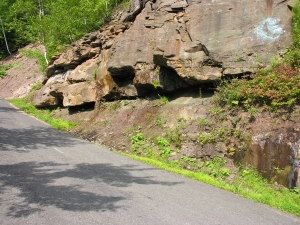
But it is the bedrock geology that we would like to talk about today. A lot of rock had to be cut through and carted off to make way for the road and that has provided us with a fine outcrop. Just before the bend you will see about 40 feet or so of massive sandstone. That is the cross section of an ancient river. we, of course, really mean it when we say ancient. We are talking about the Devonian time period, about 385 million years ago. There was a river here then and it flowed across a vast floodplain. This ancient stream had nothing to do with today’s Plattekill Creek; it is just a nameless river, lost in the annals of Earth history. The river itself was prone to times of high and active flow. If you look at the strata here, you will see the evidence: Steeply inclined strata called cross beds. In our mind’s eye, we envisioned days when very powerful flows of water had passed by here.

Above the river deposit there are five feet or so of red shales. These are old floodplain sediments; they were deposited during the floods that occasionally swept through here. The red color fades at the top in what is an old soil profile. It’s only five feet of red strata, but what a record of time! These sediments record untold numbers of floods and the long slow process of soil formation.

As you round the bend in the road you find another ten feet or so of river sandstones. We look at rivers today and think of them as permanent landscape features, but they are not. Floodplain rivers come and go; they slowly meander back and forth, snake-like, across the flat lands. A river will occupy a site for a long time, then meander off, and much later, it may meander back. Or maybe some other river will meander into the same site. That’s what you see at the bend in the road. First there was one river, then a red floodplain, and then the same or another river returned to this site.

Continue up the road and then you will see that there is still another five feet or so of red floodplain with the paleness of another fossil soil. Above that is the single best geological feature of the site. That second red floodplain is followed by a truly massive river sandstone. There must have been a very large river here, one that deposited a lot of sand, about 50 feet or more. But it is right at its base that we found the best feature. The sandstone has eroded an overhang above the softer red shales. Look under and up at the sandstone and you will find what we call “drag marks.” Drag marks are just that. Something, probably a waterlogged tree trunk, was dragged down the stream by the river currents. It dragged into the muds and left the mark. Actually, there are two of them. They represent just the few seconds it took for a log to move along and leave the drag mark. But those few seconds have been recorded there in the rock, for nearly 400 million years.

The bend in the road is an especially nice exposure of some very typical Catskill stratigraphy. If you spend a little time here and work your way through the site’s stratigraphy you will learn a lot about our area rocks, and it’s not very complex. Basically, the light sandstones are river channel deposits, and the red shales are old floodplain sediments. You can apply what you have learned here, throughout most of the Catskills. That’s a lot of knowledge.

Contact the authors at randjtitus@prodigy.net. Join their facebook page “The Catskill Geologist.”
A new book about an old forest – June 16, 2022

in Uncategorized by

THE CATSKILL GEOLOGISTS BY PROFESSORS ROBERT AND JOHANNA TITUS

A Book about the fossil Gilboa Forest

Our Catskills can hardly be portrayed as being a great center for scientific studies; there are no great research universities here, nor any high-powered labs. But these mountains are known all around-the world for one enormously important scientific fact. The Catskills are home to some of the oldest known examples of forest ecologies. We mean not just fossil trees but actual fossilized forest ecologies. Our Catskill Mountains are essentially a petrified delta. It’s called the Catskill Delta from the Devonian time period of about 420 to 360 million years ago. The strata of our mountains, here and there, display patches of what can be called the Gilboa Forest, an assemblage of very early and very primitive trees. With them are the weeds, bugs and fish that lived on the soils and in the rivers of that delta. It is an enormously important record of a critical chapter of evolution, when life was moving out of the oceans and onto the land

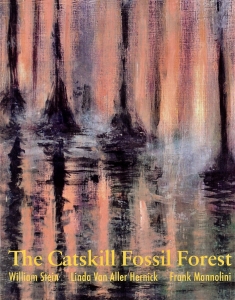
Sadly, the scientific literature about the Gilboa Forest has almost always been written in a nearly impenetrable technical prose. Now, at last., three of the today’s principal researchers have put together a book aimed at introducing the Gilboa Forest to the people of the Catskills: “The Catskill Fossil Forest.” These authors, Binghamton University professor William Stein and State Museum geologists Helen Van Aller Hernick and Frank Mannolini, feel an obligation to the people of the Catskills to explain their science. The book, published by the Gilboa Historical Society Press, is an account of recent studies of fossil forest in Gilboa, Cairo and South Mountain in the eastern Catskills. We learn of the step-by-step uncovering of these three important fossil sites and are introduced to the major categories of fossil trees that were brought to light. The book is brief and extremely well illustrated. It is a most unusual and remarkable effort by professional scientists to explain their work to the local community. It is expected to be introduced at a book signing between 11:00 and 4:00 at the Juried Museum in Gilboa on Sunday. June 12th.

But, while aimed at the general public, this is indeed a book of science. You need to know how to read it. First, this is not a novel; you just don’t start at the front and read through it, cover to cover. In fact, you might begin by spending a fair amount of time looking at the illustrations, especially those of the different fossil trees. Look them over and read the legends. Much of science is communicated through illustrations so you can learn a lot from this. You can also start picking up the Latin terminology and that will prepare you better to read the main text. After all, if you are going to be reading about Pseudosporochnalean and Eospermatopteris trees, then it really helps to have the right images in your mind. And there’s another big plus, you’re going to feel so incredibly smart knowing these words and so many others. All this may be tough at first, but you can do it.

And then there are the insets. The authors have picked out a large number of special subtopics for special readings, separate from the main text. They are important and often quite interesting. Each is a separate bit of education. You should spend time just browsing these.

We strongly recommend this book. If you enjoy our columns, then you will certainly want to learn what is presented in this account. It’s important science. Local science.

It is available at the Gilboa Museum gift shop and at local bookstores. Online at gilboafossils.org/store-home/


Contact the authors at randjtitus@prodigy.net. Join their facebook page The Catskill Geologist. Read their blogs at “thecatskillgeologist.com.”

Why winter happens 6-9-22

in Uncategorized by

The Reasons for Seasons

Stories in Stone; The Columbia County Independent

Updated by Robert and Johanna Titus


Our Hudson Valley region summers generally bring wonderful weather with dry air and cool nights. Our autumns are spectacular with their foliage. Our winters are dreadful, and once again it is that time of the year. We stoically accept the onset of another cold season and make do with the holidays as some sort of compensation. Few of us, however, know or even wonder why we must endure this annual season. Do you? Some of you might be able to give a reasonably good explanation for our winter season in terms of the Earth’s orbit about the Sun. Many of you, however, might flub the story; it is just a bit complex.

But it really doesn’t matter; We are not interested in the standard astronomical explanation of winter. We would like to consider a deeper reason, in fact, the real reason it is cold out there right now, and that has less to do with the Earth’s orbit than it does with the what’s right above you, or rather, what is not right above you. Read on:

Even if your astronomy is not very good, most of you can probably run through a quick description of the greenhouse effect, it’s one of the leading environmental fears we face today. Briefly, our world’s industries are burning fossil fuels and pumping out large volumes of carbon dioxide into the atmosphere. Carbon dioxide traps solar energy in our atmosphere much the way the glass traps solar energy in a greenhouse. As industrial production of carbon dioxide continues, it may be that the Earth’s climate will warm up with all sorts of unfortunate side effects. Such a fate is sometimes referred to as the “Greenhouse Earth.”

But what if it were the other way around? What if the quantities of carbon dioxide were declining instead of increasing? That gets us to a term which is rarely used – the “Icehouse Earth.” That’s a notion few have been much worried about nowadays, but it actually has happened, and that gets us back to what isn’t above you. In earlier columns we wrote that there were, in the distant past, great mountains towering above our Columbia County region along with most of western New England. These mountains are called, by geologists, the Acadians. They should not be confused with today’s small Taconics and Berkshires; these mountains rose to elevations of tens of thousands of feet and that was right here. That was during the late Devonian time period or about 375 million years ago.

This had been a time when the world was truly a Greenhouse Earth. There was actually 16 times as much carbon dioxide in the Devonian atmosphere as is today. That greenhouse effect must have been enormous; tropical climates prevailed across the planet. But it was not to last. Here in today’s New England, our rising Acadian Mountains were subject to chemical weathering and erosion. Those processes converted the Acadians into sediment which, eventually, hardened into rocks deposited across the rest of New York State. What is critical here is that the processes of chemical weathering consume carbon dioxide; they take it right out of the atmosphere. As the Acadians weathered away, the amounts of carbon dioxide in the atmosphere dropped dramatically, from 16 times as much as today down to merely today’s levels by the end of the Devonian Period, about 350 million years ago. This, as you might guess, resulted in a reversal of the greenhouse effect and quite a cooling of the climate. In fact, there was an early ice age at the end of the Devonian.

There is plenty we don’t understand about this story, but this was a turning point in Earth history. Carbon dioxide would never again be as abundant as it was during the early Devonian. Its levels would rebound again during the age of the dinosaurs and those great hairless monsters certainly must have enjoyed the temporary restoration of the greenhouse warmth. But there simply would never again be so much carbon dioxide, and the climate would slowly deteriorate, with cooling temperatures, especially during the last 60 million years. Some argue that this cold is what caused the extinction of the dinosaurs. There is a good case that can be made for this argument too. Winters, which probably had not been much of a problem during the early Devonian, slowly became longer, colder and more distinct from the rest of the year. Thus, what we know as seasons made their appearance. The process has continued right into our time. In reality, even if industrial pollution continues unabated, ours is a time of an Icehouse Earth. Glaciers in Antarctica and Greenland attest to that.

So, were our old Acadian Mountains responsible for winter? Well, that’s a bit of a stretch, but it is fair to say that the many processes that came to produce and then destroy the Acadians were all part of a climate machine that eventually created the Icehouse Earth climate that we can look forward to for the next three or four months.

Contact the authors at randjtitus@prodigy.net. Join their facebook page “Tye Catskill Geologist.”

Roeliff Jansen Kill, Pt. 6, the floor of a lake.

in Uncategorized by

Roeliff Jansen Kill, Part 6 –Bottom of a lake

Stories in Stone

Updated by Robert and Johanna Titus


We continue our journey down the Roeliff Jansen Kill. Last time we had reached the village of Elizaville and there we found an ice age delta. Back, about 14,000 years ago, the Roeliff Jansen Kill had reached the shores of an ice age lake. It’s known to geologists as Glacial Lake Albany. For quite some time that lake represented the downstream end of the Roe-Jan and, as the river flowed into the lake, it deposited the sediments of the Elizaville Delta.

But the lake was doomed; all lakes are. Lakes are ephemeral features; time will always bring their destruction. The waters of Glacial Lake Albany eventually drained down the Hudson and into the Atlantic Ocean. That left behind a big empty basin with the Roe-Jan flowing into it.

Now the Roe-Jan tumbled over the edge of its old delta and reached the flats of the old lake bottom. This constitutes a whole new stretch of the river, and we can, of course, explore that stretch. We can see it with or without the lake waters.

From Elizaville, take County Rte. 19 north. You will soon cross a small creek and then see a large apple orchard. Just beyond the orchard, the road will cross another small creek and then start to climb uphill a bit. You have just crossed Doove Kill and are now rising up onto the Manorton Delta. Doove Kill, just like the Roe-Jan, flowed into Lake Albany and created its own delta. On the left (west) side of the road you will see a small pond. That is an old ice age pond. It formed just like Twin Ponds at Elizaville. A large block of ice was buried in the delta and, when it melted, it left behind the hole in the ground that became a pond.

What we are doing now is driving north, parallel to the shores of what had been the old lake. Look to your left and imagine the waters of Lake Albany stretching out before you. The first 50 or 100 feet of lake are covered with a thin sheet of ice. Beyond that are the open waters of the lake. There are a number of small islands out there, but it is, otherwise, a very big lake. The other side of Lake Albany is nine miles away. You can see Mount Marion rising above the western shoreline. When we look north and then south, we see the lake disappearing into the horizon; it is, indeed, a very large lake!

But we have exploring to do. We continue driving north on Rte. 19 until we reach the village of Manorton. There we take a left fork and follow County Rte. 8 off to the northwest. We begin a long steady descent and drop down from and elevation of 260 feet to one of 190 feet. We are dropping off of the Manorton Delta and our descent is a journey into the depths of Lake Albany.

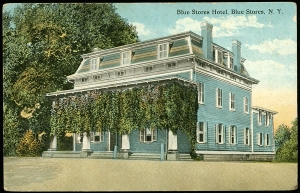
Imagine the waters deepening around you as you drive down the road and imagine it growing darker as well. Our journey takes us about a mile and a half until we get to the village of Blue Store. That’s a historic old town, but out trip is taking us well beyond what most people reckon as history. We arrive at the old hotel and restaurant and look around. The countryside here is flat and expansive; it is the floor of the lake.

It is always somewhat startling to see a flat landscape and recognize it as an old lake bottom. We are now 70 feet beneath the waves of Lake Albany. This is not a nice place to be; the water is murky and it is dark and very cold here. But, like or not, this is Blue Store as it was, about 14,000 years ago. Once again, the Roe-Jan has made us time travelers.

Contact the authors at randjtitus@prodigy.net. Join their facebook page “The Catskill Geologist.”
Go to Top