"I will never kick a rock"

Monthly archive

November 2019

Name Your Poison Nov. 28, 2019

in Uncategorized by

Name Your Poison
On the Rocks; The Woodstock Times
Updated by Robert and Johanna Titus
June 18, 1998

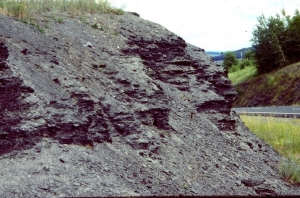
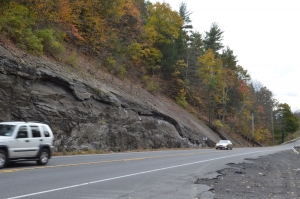
Black sedimentary rocks are occasionally seen in the Hudson Valley. Recently [1998], we described some along Rt. 209, south of Sawkill. The dark appearance of these strata makes them remarkably eye-catching and, when they make up tall cliffs, they loom, dark and menacing, over the landscapes.
It’s the shiny, jet-black shales that we are talking about. They are often rich in undecayed organic matter; it’s the carbon that makes these rocks black. This generally suggests to the geologist that there were low-oxygen conditions in the sea waters at the time of deposition. Without oxygen, most decay bacteria cannot function; they die before they can completely destroy the organic matter. But why low oxygen? That takes us back in time.

Back in the early Devonian Period, these shales were accumulating in a deep sea, immediately adjacent to the rising Acadian Mountains of western New England. Thick soils formed on the rapidly weathering mountainsides. The soils were easily and rapidly eroded and provided sediments that were eventually transported into the nearby Catskill Sea. This material was rich in dissolved nutrients, such as nitrates and phosphates. They fertilized the water and that led to the next step in what was to be a complex chain of events.
The fertilized waters were ideal for algae; they experienced algal blooms, great population explosions in the surface waters of the Catskill Sea. A whole ecology became established as dense mats of floating, or planktonic, plants and animals grew, somewhat similar to that of today’s Sargasso Sea. While all this was great for the plankton it was deadly for just about every other category of marine organisms. As the plankton died, they were attacked by decay bacteria; the algae bloom led to a bacteria bloom. But the decay process consumed so much oxygen that the seas soon became oxygen depleted. The hapless bacteria had, in effect, poisoned their own habitat, because they needed oxygen too. Their numbers quickly plummeted and very soon, all types of animals suffered as well, suffocated in the oxygen depleted sea. But the algae just kept on proliferating in the surface waters where there was plenty of oxygen, diffusing in from the air above. Soon, large masses of undecayed biological material were sinking to the floor of the ocean. The climate was tropical, and the nearby coastal lowlands provided lots of vegetation, much of which drifted into the basin, adding more organic matter to the black shales. Almost all of these organics accumulated as thinly laminated, shiny black shales.
Back then, the Catskill Sea was largely isolated from other deep bodies of water; it was nearly surrounded by land or very shallow water. To its east, land blocked weather patterns and shielded the basin from most storm activity. All of these conditions promoted what are called stagnant, thermally stratified waters. The sunbaked surface layer was hot, while deeper water remained cool. Depth stratification and a dense planktonic mat combined to prevent agitation and mixing of the waters, causing stagnant sea floor conditions to develop. Virtually nothing could live in this sea, except at the surface where there was always plenty of oxygen. This was truly the poison sea.
Many of the earliest Catskill shales are jet black, and they form the Bakoven Shale at the base of what is called the lower Marcellus Group. As we have seen, they are the record of the Catskill poison seas. The upper beds of the Marcellus Group are similar looking but very different deposits. These are fossiliferous black shales and dark gray sandstones. They sometimes have rich assemblages of brachiopods, clams and even corals. These were still mud-bottomed seas, but they were deposited at times when there was a fairly large amount of oxygen in the water, at least enough to allow marine shellfish to survive and even flourish. These can be fun rocks to poke through as they are occasionally richly fossiliferous, and the preservation of those fossils can be very good.
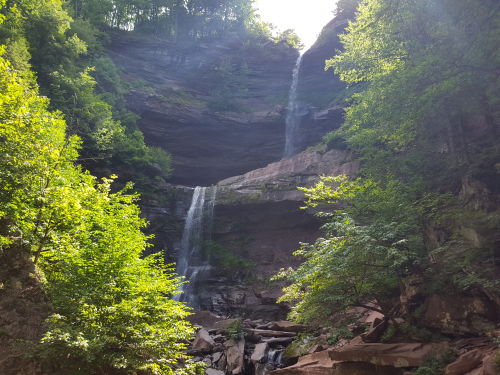
See the Bakoven Shale on Rte. 23A where it crosses Kaaterskill Creek east of Kiskatom. Go visit that large outcrop along Rte. 209, between Kingston and Sawkill. The far south end is the real poison sea; as you travel upwards and north from those beds you are looking at shallower waters which had more oxygen.

Contact the authors at randjtitus@prodigy.net. Join their facebook page “The Catskill Geologist.”

Gaps in our knowledge Nov. 21, 2019

in Uncategorized by

Gaps in our Knowledge
On the Rocks/ The Woodstock Times
Jan. 22, 1998
Updated by Robert and Johanna Titus

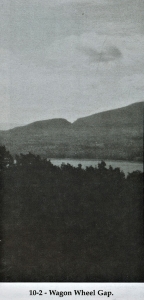
Take Rte. 28 west from Woodstock, turn right at Dancing Rock Road (it’s two miles east of Boiceville) and go up one mile to the end of the paved road. Look south and, there below, is the Ashokan Reservoir. Above it, on the horizon, is High Point Mountain. The mountain profile is nothing particularly unusual except for one feature. There is a notch cut into the top of the mountain. It is the sort of landscape feature that you pay little heed to; it doesn’t seem all that strange until you look at it carefully and ask a simple question. How did it get there?
The notch has a name: it’s Wagon Wheel Gap. we suspect that the name came from the deep ruts that old fashioned wagon wheels carved into roads before the auto age. The gap is at least 200 feet deep and steep on both sides. It seems to be something cut into the mountain. It was. Not surprisingly this odd landscape feature does have a story to tell and it is a surprising one.
Wagon Wheel Gap is a glacial feature, but different from most. Glaciers are very good at eroding landscapes and they can carve notches into the landscape. But that kind of glacial erosion produces a nice, smooth, U-shaped gap. West Kill Valley is a good example. It’s relatively wide and rounded at the bottom. Stony Clove is narrow like Wagon Wheel Notch but it has been cut right down to the level of the valley. Wagon Wheel Gap is altogether different. There’s nothing broad and round about it. It’s a sharp slash, like something cut by a knife. The bottom of the gap lays well above the level of the nearest valley, in fact 700 feet above. Wagon Wheel Gap seems something quickly and violently cut into the High Point mountain.


The story of Wagon Wheel Gap takes us back about 17,000 years. At that time a large glacier was pushing up the Esopus Creek valley. It passed the present site of the Ashokan Reservoir and pushed on; we are not sure how much farther. This ice did reach a still-stand and then, with warming climate, it began a slow retreat. The warming halted briefly, and the glacier reached another still-stand, just exactly abutting against the present-day gap.
The ice acted as a dam and so it blocked the whole upper Esopus Creek which then filled with a reservoir of cold water. The water had to drain off somewhere and it made its way across the slopes of High Point and drained off to the south. In what had to be a very short period of time, that flow of water cut into the mountain and carved the gap we see today. It’s quite something to imagine. There would have been an enormous amount of water pouring through the gap back then. There would have been all of the normal flow of the Esopus Creek plus all the water provided by the region’s melting glaciers. That’s a lot.
The flow must have positively raged through the Wagon Wheel, perhaps the mother of all whitewater flows. And loud too, a thunderous, pounding cacophony. It must have torn into the mountain with an effect something akin to a buzz saw. At any rate, the flow must have continued while the Esopus glacier retreated down the valley. Eventually the flow of water must have found other ways out of the valley and Wagon Wheel Gap would have been very abruptly abandoned. The whitewater flow would have dried up overnight.
And there it lies today, an abandoned notch, lying there silently in the mountain. It’s a landscape oddity with a colorful past. But how many people know even to notice such a thing. It’s, to most, just a notch in the mountain, nothing of note. What a marvel it is that glacial geologists can come along and understand these things.

Contact the authors at randjtitus@prodigy.net. Join their facebook page “The Catskill Geologist.”

Voyage to the bottom of the sea – Nov. 14, 2019

in Uncategorized by


Journey to the bottom of the Sea
On the Rocks; the Woodstock Times
April 30, 1998
Updated by Robert and Johanna Titus

We geologists, over and over, are used to seeing vivid moments from the past, recorded in the rocks. We never become blasé’ about this, and we shouldn’t; we are privileged to have these visions. We were reminded of this recently when we encountered an especially fine outcrop along Rte. 9W, at Glenerie Falls about a mile and a half south from its intersection with the Glasco Turnpike. It’s the Glasco Limestone which is commonly seen along the highway hereabouts. There was one very broad surface which caught our attention. It’s a bed of rock so steep that we found it difficult to climb, but that mattered little as the bed slanted down to the level of the road. The strata, dipping to the west, are typical of this vicinity. These rocks got caught up and tilted in the deformation associated with ancient mountain building in New England.


What makes this such a fine exposure is that there is one particular stratum which is expansively exposed. That’s unusual. We geologists spend a lot of time looking at strata in cross section, but we rarely get to see a broad surface like this. Once again, we had become time-travelers; this bit of geology had taken us back in time to the Late Silurian time period. We don’t mean that figuratively, but quite literally; this stratum of sedimentary rock was deposited on the floor of a sunlit shallow sea perhaps 425 million years ago. For a time, it actually was the sea floor and, upon it, grew the seaweeds and crawled the shellfish of the old Silurian age sea.
But time is fleeting, even geological time. Sooner or later (and in geology it really can be later) a sea floor is condemned to be buried. Storms blow up and the winds generate currents which bring new masses of sediment to be spread about. Many of the plants and animals that populated the old sea floor remain, but only as fossils. Layer after layer of sediment piles up and the sea floors of old harden into strata of rock lost in time. That’s what geologists see in cross section when they study layered road outcrops such as most of those on Rte. 9W.
But not all of the strata here have shared that inglorious fate. There is, for example, this one fine stratum. It’s an example of something unusual, an exhumed sea floor. Nature (helped a lot by the highway department) has stripped the overburden off of this old sea floor and exposed it for us to see.
You have, quite likely, been on a boat that cruised above the floor of a shallow sea. It’s a lot of fun; you can look down and observe the marine life going by below. Glass-bottom boats are specifically designed for this. In Florida or the Bahamas, you can’t beat it for a fascinating afternoon. It’s nice that we can do the same thing right here in Ulster County.
Our stratum, along Rte. 9W, can’t quite compete with a glass-bottom boat in the Bahamas. All of the old seaweeds are gone, so too are most of the animals. All those creatures without skeletons or with only delicate skeletons are lost to time. Only those shellfish that had sturdy shells remain, but there are plenty of them. We found quite a few brachiopods, those bivalve shellfish that remind us of clams. They occurred in clusters of specimens, all about the same size. We think that these were what biologists call “spatfalls,” clusters of larval brachiopods that settled here and grew up together. These are “families” of shellfish, if you can imagine such a thing. We found a few clams here as well, but they weren’t common. Finally, we found the weathered and forlorn tail of a trilobite, all that remained of a once fine-looking animal. All in all, what we were looking at was a snapshot of the old Silurian sea floor, just a moment in time, nothing special and maybe that’s why it is special.
Because of its steepness, this old sea floor is difficult to climb around on. If you visit the site, be very careful. One slip and down you go. The fact is, however, that there is no real need to climb up the exposure at all, most all the good things you can see are found at the base of the outcrop. There’s no real need to climb any higher. So do go and see this little natural wonder. You don’t get many opportunities to explore a sea floor, especially one that existed 400 million years ago.
Contact the authors at randjtitus@prodigy.net. Join their facebook page “The Catskill Geologist.”
Floods on Overlook Mountain 11- 6 – 19

in Uncategorized by

FLOODS ON THE OVERLOOK TRAIL
On the Rocks
The Woodstock Times, Oct. 1996
Updated by Robert and Johanna Titus

It’s autumn and it’s a time when we in the Catskills are given some of the best weather there is to enjoy the outdoors. There are few places better suited to the mood of the season than the Overlook Mountain trail. The word trail is a bit of misnomer. This was once a highway of some significance, but those days are over; it’s just a hiking path now.
The trail takes you past Echo Lake and onward toward Plattekill Clove. There are the subtle signs of a history along the way. You can see where quarry stone was used to reinforce the road for heavy traffic. It was needed; the Overlook Road once carried wagon loads of heavy Catskill bluestone. There were a lot of active quarries up there once, especially at the north end of the one-time highway. Look for a fork in the trail there, where the Blue, Red and Green Trails intersect. Within a few hundred yards of that spot are quite a few of the old quarries.
Some quarries are overgrown, but most are very much as they were on the day that operations halted. Quarrymen sought after flat-lying stratified sandstone, sometimes called flagstone, but mostly called bluestone. The rock easily split along its strata into stone useful for sidewalks and as various types of building stone. If the rock wasn’t made of flat-lying strata they left it be; it was of no monetary value and therefore of no interest. But it’s that odd stone that is of the greatest interest to a geologist; the non-flat lying strata tell the best stories.
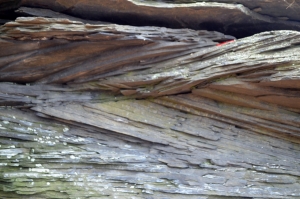
Much of the rock which ended up left behind is what we call cross-bedded sandstone. These are very nicely defined strata which occur in sets that are never horizontal but intersect each other at all sorts of angles. The pattern is eye-catching; the rock seems to possess a written record of its own history, a hieroglyphic if you could only read it. It does and you can.

Most bluestone was once sand that was deposited in ancient stream channels. That was about 380 million years ago during the Devonian time period. Cross-bedded sands of this sort form in the deepest, most rapid flowing part of stream channels, a churning, swirling time in the history of those ancient rivers. Rapid and strong currents scoured out troughs on the stream bed. Later, when the currents slowed down, sand was deposited, and it filled in the original troughs. Over and over the process was repeated and eventually the cross-bedded sands formed. Streams of this sort tend to shift their channels as they meander across the flood plain, and the sands were left behind under a thickening accumulation of flood plain deposits. When thick enough the pressure began to harden the sediment into the sandstone we see today.

These deposits accumulated at times of maximum flow and these are likely to have been floods. Floods to humans are awful events, powerful and destructive episodes when stream banks collapse and plants and animals are killed. Nowadays when floods happen, newspaper headlines scream of the damage. Remember last January [1995] in the central Catskills.
But these were events which occurred long before people. All the terrible events that we associate with modern floods occurred here; surely many primitive animals died, and perhaps whole forests were washed away. But no one was there to mourn the losses, nobody cleaned up or repaired the damage. No newspapers or history books recorded these awful events and life just went on. Only the rocks carry the “hieroglyphs” of these terrible moments in the deep-time history of our region and only geologists can read them.
If you get a chance, pick one of those beautiful, clear, dry, warm fall days and go hike the Overlook trail. Find some of these cross-bedded strata. These were awful moments that Nature prefers to forget. There is violence and power here, there is noise and turmoil, there is the struggle for, and giving up of life. Take a good look at these strata and appreciate the history they record. Such things can give you a whole different point of view on rocks.

Contact the authors at randjtitus@prodigy.net. Join their facebook page “thecatskillgeologist.com.”

Go to Top