"I will never kick a rock"

Monthly archive

February 2019

Name your Poison Feb 28, 2019

in Uncategorized by

Name Your Poison
On the Rocks/
Updated by Robert and Johanna Titus
June 18, 1998

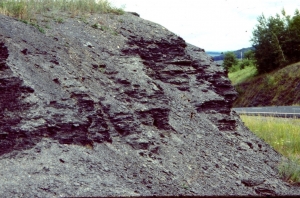
Black sedimentary rocks are occasionally seen in the Hudson Valley. Recently, we described some along Rt. 209, south of Sawkill. The dark appearance of these strata makes them remarkably eye-catching and, when they make up tall cliffs, they loom, dark and menacing, over the landscapes.
It’s the shiny, jet-black shales that we are talking about. They are often rich in undecayed organic matter; it’s the carbon that makes these rocks black. This generally suggests to the geologist that there were low-oxygen conditions in the sea waters at the time of deposition. Without oxygen, most decay bacteria cannot function; they die before they can completely destroy the organic matter. But why low oxygen? That takes us back in time.
Back in the early Devonian Period, these shales were accumulating in a deep sea, immediately adjacent to the rising Acadian Mountains of western New England. Thick soils formed on the rapidly weathering mountainsides. The soils were easily and rapidly eroded and provided sediments that were eventually transported into the nearby Catskill Sea. This material was rich in dissolved nutrients, such as nitrates and phosphates. They fertilized the water and that led to the next step in what was to be a complex chain of events.
The fertilized waters were ideal for algae; they experienced algal blooms, great population explosions in the surface waters of the Catskill Sea. A whole ecology became established as dense mats of floating, or planktonic, plants and animals grew, somewhat similar to that of today’s Sargasso Sea. While all this was great for the plankton it was deadly for just about every other category of marine organisms. As the plankton died, they were attacked by decay bacteria; the algae bloom led to a bacteria bloom. But the decay process consumed so much oxygen that the seas soon became oxygen-depleted. The hapless bacteria had, in effect, poisoned their own habitat, because they needed oxygen too. Their numbers quickly plummeted and very soon, all types of animals, as well, suffocated in the oxygen depleted sea. But the algae just kept on proliferating in the surface waters where there was plenty of oxygen, diffusing in from the air above. Soon, large masses of undecayed biological material were sinking to the floor of the ocean. The climate was tropical, and the nearby coastal lowlands provided lots of vegetation, much of which drifted into the basin, adding more organic matter to the black shales. Almost all of these organics accumulated as thinly laminated, shiny black shales.


Back then, the Catskill Sea was largely isolated from other deep bodies of water; it was nearly surrounded by land or very shallow water. To its east, land blocked weather patterns and shielded the basin from most storm activity. All of these conditions promoted what are called stagnant, thermally-stratified waters. The sunbaked surface layer was hot, while deeper water remained cool. Depth stratification and a dense planktonic mat combined to prevent agitation and mixing of the waters, causing stagnant sea floor conditions to develop. Virtually nothing could live in this sea, except at the surface where there was always plenty of oxygen. This was truly the poison sea.
Many of the earliest Catskill shales are jet black, and they form the Bakoven Shale at the base of what is called the lower Marcellus Group. As we have seen, they are the record of the Catskill poison seas. The upper beds of the Marcellus Group are similar looking but very different deposits. These are fossiliferous black shales and dark gray sandstones. They sometimes have rich assemblages of brachiopods, clams and even corals. These were still mud-bottomed seas, but they were deposited at times when there was a fairly large amount of oxygen in the water, at least enough to allow marine shellfish to survive and even flourish. These can be fun rocks to poke through as they are occasionally richly fossiliferous, and the preservation of those fossils can be very good.
See the Bakoven Shale on Rt. 23A where it crosses Kaaterskill Creek east of Kiskatom. Go visit that large outcrop along Rt. 209, between Kingston and Sawkill. The far south end is the real poison sea; as you travel upwards and north from those beds you are looking at shallower waters which had more oxygen.

Contact he authors at randjtitus@prodigy.net
A petrified delta Feb. 21, 2019

in Uncategorized by

A Petrified Delta?
The Catskill Geologists
Updated by Robert and Johanna Titus

We’re back! Did you read us back when The Mountain Eagle was part of Columbia-Greene Media? Well, here we are again. We will be making frequent contributions to the “new” Mountain Eagle and hope you will be watching for us. We are Robert and Johanna Titus, and we have a long history of writing geology columns here in the Catskills. Run a search on us and you can learn a lot more.
When you begin writing for a newspaper the first thing you ask is about where does it circulate. The Mountain Eagle can be found throughout all of Schoharie County and a good part of Greene and Delaware Counties. That is the heart of the Catskills and that gives us a lot of geology to write about. So, a good place for us to start today is to describe the geology of our mountains in the broadest terms. Let’s ask a deceptively simple question: What are the Catskills?
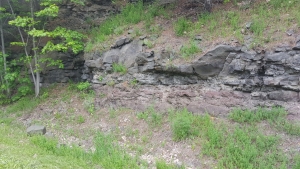
And (without a drumroll) the answer is – the Catskills are a petrified delta. A what?? Does that surprise you? Well then, maybe you need to start learning some geology. Let’s begin by looking at a typical outcropping here in the Catskills. See our photo; the upper half of this outcrop is typical Catskill sandstone. It’s often called bluestone, but it is actually brown to gray. There is a lot of similar sandstones found throughout the Catskills. We would like you to be watching for these stratified rocks as you travel around.
That sandstone was once sand and that means there must have, long ago, been an environment of deposition that accumulated this sediment. What was it? Geologists have been studying these sandstones for more than a century and they have concluded that these sands were deposited in the channels of ancient rivers. When you find a thick sandstone of this type, we would like you to pause in front of it, and imagine the currents that once passed through right where you are standing. Hold your hand up and feel those long-ago currents; you are now using your mind’s eye, and you have traveled into the distant past; what geologists call the deep past.
How old are these sandstones? Geologists have been collecting fossils in the Catskills for almost two centuries. The ages of these fossils goes back to a time called the middle Devonian. That makes these stratified rocks roughly 380 million years old! Can you imagine anything being that old?

The strata at the bottom of our photo are red shales. The key is the color. This sort of red is an iron oxide, typical of an ancient terrestrial setting. These shales were originally muds and they were deposited in what geologists call overbank settings. That means these red shales were the soils on the floodplain that our river flowed across. All around the world today we see similar red soils. They are almost always found in tropical settings; you will see a lot of such soils in the Amazon and Congo Basins. So, now our typical Catskills outcrop has brought our mind’s eyes onto a Devonian age, tropical floodplain, watching a river flow by. But, why is this a delta?
Geologist have found that these Catskills sediments lapped up against the western Appalachian sequence. These, the rocks of New England, are the roots of an ancient mountain range. These were not the Appalachians; instead geologists call them the Acadians. It is estimated that these Acadians were, back during the Devonian, between 15,000 and 30,000 feet tall. Only the Berkshire and Taconic Mountains remain; what happened to the rest?
They eroded away.
These lofty mountains were destroyed by weathering and erosion, and their bedrock crumbled into enormous quantities of sediment. That sediment was transported by sizable rivers and it came to be deposited on something called the Catskill Delta. The delta was spread out west of the Acadians. And it is that delta, now petrified, that makes up the Catskills where the Mountain Eagle can be read.
Contact the authors at randjtitus@prodigy.net Join their facebook page “The Catskill Geologist.”

The Hoogeberg Range Feb. 14, 2019

in Uncategorized by

The Hoogeberg Range
On the Rocks – The Woodstock Times
Updated by Robert and Johanna Titus

We often use lots of words without having a precise notion of what they mean. English is designed for that as sometimes its words need to have just a touch of (appropriate) vagueness. For example, just what does the word “mountain” mean? There are many good answers to that and each one is different from all of the others, and each one may still be correct. Similarly, what exactly does the word “hill” mean? It gets worse. What does “foothill” mean? Hills don’t have feet, so let’s pursue the issue and do it with a good local example.
The Catskills are often called mountains although many debate that heatedly. Our Catskill Mountains have foothills and some of those are very close to Woodstock. The foothills that we are speaking of are the hills of the Hoogeberg Range. If you have never heard the term that’s quite excusable, the Hoogebergs are not great or famous peaks.


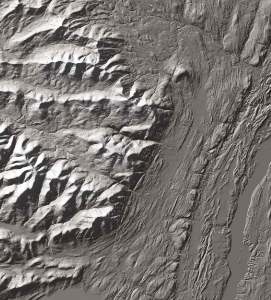
The Hoogebergs are a series of small hills lying parallel to the Catskill Front, the great eastern escarpment of the Catskills. They are found just a few miles east of the Catskills and rise to only 600 or 700 feet in elevation. That’s merely a third of the elevation of the Catskills themselves. Thus, they are adjacent and parallel to Catskills, but short. They are like a practice run before the big mountains, hence the term foothills. You can see the Hoogeberg Range if you drive north on the Kings Highway (Rt. 31), south of Saugerties and Rt. 32, north of Saugerties. The ridge looms to your left (west). It forms a fairly impressive horizon.
You can easily go and see the rock that makes up the Hoogeberg Range. There are several locations where there are gaps in these hills, and they let you drive right through the bedrock. Rte. 212 cuts through at the village of Veteran, Rte. 32 cuts through at Quarryville and the Glasco Pike cuts through at the village of Mt. Marion. In each of these locations there are fine exposures of the bedrock right along the road.
What is the Hoogeberg and why is it here? Visit the Rte. 212 exposures and you will observe some very fine, thick, rugged sandstones. These are tough rocks and they have resisted the efforts of weathering and erosion. To the east and west, softer rocks have eroded away, and as they did the Hoogeberg came to be sculpted into a series of hills. These sandstones belong to a geological unit called the Mt. Marion Formation. It is mostly this sandstone and it makes up the Hoogeberg Range. Park along Rte. 212 here and poke around for a bit and look the sandstones over. You may find the fossils of some marine shellfish. That tells us a lot. The Mt. Marion sands accumulated at the bottom of an ocean, sometimes called the Hamilton Sea. The sands once made up the floor of that sea.

At the Glasco Pike exposure you will learn more about the Mt. Marion and the Hoogeberg. This outcropping is at the bridge which crosses Plattekill Creek. The lower levels of the exposure are mostly black shale. Up above, however, those sandstones make their appearance. We talked about this in an earlier column. This sequence of strata records a transition from an offshore, deep water setting to a nearshore, shallow ecology. The offshore accumulated muds that hardened into the shales while coastal sands would eventually harden into the Mt. Marion sandstones.
If you look carefully you may notice that the strata at these locations are not perfectly horizontal; they dip gently to the west. These rocks were all here during the late Devonian time period and they were involved in crustal tilting that was part of a mountain building process, then going on in New England. The tilting of these resistant strata raised those sandstones and exposed them to erosion. They responded by eroding into the hills we see today. The tilting accounts for much of the form of the Hoogeberg. Its west-facing side is generally a gentle slope, reflecting the original tilting, while the east-facing front was eroded into a steep slope, often a cliff.
Crustal tilting, shallowing seas, ancient shellfish, there’s a lot of history in these pretty little foothills and they do make up a significant feature in our local landscape, even if they are just foothills.

Contact the authors at randjtitus@prodigy.net. Join their facebook page “The Catskill Geologist.”

Honk if you love reefers Feb. 7, 2019

in Uncategorized by

Honk of You love Reefers
ON THE ROCKS – The Woodstock Times
May 21, 1998
Updated by Robert and Johanna Titus

We geologists owe a great deal to the highway departments. It is necessary for them to cut great slashes into the hills and mountains so as to allow the passage of roads. And thus it has been that they have, especially since the 1950’s, been providing us with thousands of beautiful exposures of bedrock. Many of these are quite impressive – great, towering cliffs of rock, rising above the passing traffic. They are like magnets to geologists, they lure us to stop and explore.
Rte. 209, south of the Saw Kill, displays one of the area’s better exposures. It’s a very impressive cliff of black stratified rock. The beds of rock here are called the Mt. Marion Formation. That’s one of the area’s more important units of rock. It’s a big, thick sequence of sandstone and shales; the beds piled up to a thickness of about 500 feet. Not surprisingly, these are the layers of rock that make up Mt. Marion itself.
The sedimentary rocks of the Mt. Marion Formation record a distant moment in the history of this region. They were deposited as black muds and dark sands at the bottom of the relatively deep ocean that once existed throughout all of eastern New York State. But that was about 380 million years ago.
As we said, these exposures are irresistible magnets for all geologists, and we are no exceptions. We drove down Rte. 32 and turned onto the Rte. 209 ramp and took a nice slow drive along the great exposure. It was well worth the effort; our luck was very good.
Practically the very first thing that we noticed was a fine specimen of a fossil coral. That was a big surprise, as we had never imagined that this would be a place to search for corals. We usually find fossil corals in limestones. Limestones record ancient shallow, tropical seas, places ideal for corals to grow and flourish. In such locations, corals grow into the great colonies that we know as coral reefs. Each reef is composed of thousands of individuals living together in a single colonial skeleton. But as we looked up at the strata of the Mt. Marion Formation, we could not imagine such an image for this unit of rock.

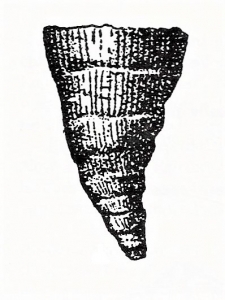
Black shales and sandstones are different from limestones. They accumulated on murky, dark sea floors, places not usually well-suited for corals. But the corals we found here were not the regular run of the mill forms; these ones are known as horn corals. Horn corals are, as the name implies, uncanny duplicates of the horns of cattle. They are widest at the top and taper downwards to a point. The specimens we had collected are probably called by the Latin name Cyathophyllum. They would have been pretty well-adapted to life on the dark, muddy sea floor. We suspect that they grew upwards so that their sharp pointed bottoms stuck into the mud like golf tees. Their wide openings would have projected above the sea floor and they would have avoided being clogged with mud.
Corals are predators of sorts; obviously they do not stalk their prey. Instead they are known as “awaiters;” they lay upon the sea floor and wait for some unwary prey to come by. They have tentacles that capture their prey and pull these victims into their gullets for digestion. That’s not a very exciting life, but it works well; corals have been around for about half a billion years and they are likely to be around for another similar length of time.
And, so it was, as we drove along the black shales of Rte. 209, that we imagined ourselves at the bottom of an ancient sea. All around us, on a dark muddy bottom, lay numbers of horn corals with their light colored, fleshy tentacles waving back and forth at the surrounding waters, each one grasping greedily in hopes of food. There is certainly a great difference between the world as it is, and the world recorded in the strata.
Contact the authors at randjtitus@prodigy.com. Join their facebook page ‘The Catskill Geologist.”

Go to Top