"I will never kick a rock"

Monthly archive

October 2021

Glasco Pike #2 – The Poison Sea 10-21-21

in Uncategorized by

The Poison Sea

On the Rocks; The Woodstock Times; Feb. 3, 2011

Updated by Robert and Johanna Titus


We have been, in this column, spending several months driving west on the Glasco Turnpike. We are actually exploring time. Our goal is to come to truly understand something about the passage of enormous lengths of time and to see how a region changes through those lengths. This is the vicinity of 74 degrees west longitude and 42 degrees north latitude. We want to see how this dot on the globe changed as millions of years of the Devonian time period passed by.

We are also interested in testing the theory of evolution. Darwin’s great theory predicts that the world is very old. Creationists, who challenge the theory, often argue that the planet is only 6,000 years old. Who is right? We shall continue to see some of the evidence.
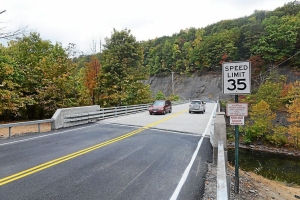
Last time, we visited the Helderberg Limestone, along Rte. 9W. This time let’s turn west onto the Glasco Turnpike itself and cross the bridge. There on the other side is a very fine outcrop. It is definitely not the Helderberg Limestone; it is a towering cliff of fine grained, black rock. The unit has a name; it is the Esopus Shale. That’s a bit of a misnomer as the rock is not actually shale. Geologists have struggled to find just the right name for it, without much success. Some call it the Esopus Grit and that might be as good a name as any. Whatever its name, it does have a story to tell.

If you visit the site, you will see what appears to be stratification in the rock; these “strata” are nearly vertical. That is an illusion. We will come back to this in a later column, but for now, take a closer look. About two thirds of the way up the outcrop, you can see the real strata, they are very faintly seen as bands of dark and very dark gray. These strata, like other rock units in the area, are tilted to the west.

To us, what this rock is today is less important than what it was in the distant past. It is Devonian in age, and a little less than 400 million years old. This dark, fine-grained rock used to be dark, fine-grained sediment. Anybody would have looked at it and called it mud. Back in the Devonian the mud would have been very wet and squishy. It quite likely would have reeked with a foul, maybe sulfurous stink.

This sort of stuff accumulates at the bottom of a very deep and very stagnant ocean. Stagnant seas never have enough agitation to bring oxygen in from the air above and, in the absence of oxygen, there is no decay. Without decay, all the black organic matter remains well preserved and hence the dark, malodorous nature. Today, the Black Sea of Asia is a modern analogue; scientists, such as Bob Ballard of Titanic fame, have to technology to actually go down and see such a deep seafloors. But we are the mind’s eye and we don’t need technology.

We would like you to stand along the edge of the highway here and wave your hand through the space around you. This space was once at the bottom of a very deep sea. We are the mind’s eye and we can go back to that seafloor. It’s inky black, too deep for any light to penetrate. These are the tropics and the water is quite surprisingly warm. There are no currents down here and, of course, there is no oxygen. All this helps to make it stagnant. Because of that, there are no animals to be seen. No fish have swum in these depths and not even shellfish can be found. It is a spooky place.

It is quite a contrast to our last visit into the past. Recently we stopped along Rte. 9-W and saw the Helderberg Sea. That had been a very shallow tropical sea, something of a paradise in that it had a very rich assemblage of animals living in it. Now, everything is different; the waters are deep, dark and lifeless. What happened?

Between the times of the Helderberg and Esopus Seas, the crust has experienced a dramatic subsidence; it has just plain sunk. The waters have grown progressively deeper. Off to the east there is a rising land mass and off to the west the waters are still very shallow. So the Esopus Sea is an isolated deep basin. That’s how it came to stagnate.

We have just witnessed the sort of dramatic change that can affect a region over a very long period of time, a few million years, no doubt. This is the length of time needed for evolution to occur and this is the sort of environmental change that helped to drive evolution. In this, our second stop down the Glasco Turnpike, we have continued to explore a changing geology that is very much in accord with the Darwinian view. But we still have a long way to go. (Next time: retreat of the sea)

Contact the authors at randjtitus@prodigy.net. Join their facebook page “The Catskill Geologist.”
The Glasco Pike #1″ the Tropical Sea Oct. 21, 2021

in Uncategorized by

The Glasco Turnpike 1: its Ancient Tropical Sea

On the Rocks; The Woodstock Times, 2008

Updated by Robert and Johanna Titus


Wherever you might happen to find yourself while reading this, please wave your arm through the air around you and begin to wax philosophical about it. This spot has been here for as long as the Earth has been here and that is about 4.6 billion years. Contemplate the history that has unfolded right here. Think of the plants and animals that occupied the very space where you are now. Geologists are accustomed to being awed by the things they discover and encounter and this is one of those marvels.

This location has a longitude and latitude. Woodstock is at 42 degrees latitude by 74 degrees longitude. If we could go back in time and bring a GPS device, we could find this spot and see what it was like way back when. That notion is mostly beyond the reach of science but just not entirely. We would like to take you back in time to this location and see what it was like at several important moments in time. It is all part of our effort to bring to meaning of the theory of evolution to you, the local readers.

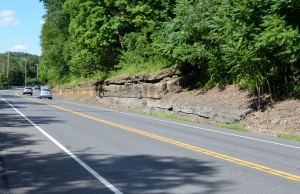
Evolution only works if the world is very old, billions of years, in fact. Our aim over the next five columns is to take a journey through time, curiously our trek will be mostly along the Glasco Turnpike. Let’s head east on the Glasco Turnpike until we arrive at its intersection with Rte. 9. Turn right, which is south, and go a short distance, just a half mile or so. Notice the gray ledges along the east side of the highway. That is our first time-travel destination.

This is the Glenerie Limestone. It is very, very fossiliferous so we geologists are very fond of these rocks; they are always a lot of fun to visit; their time is fun to visit too. As you approach the roadside outcrop, notice the horizontal layering to the rocks. This is, of course, called stratification. The marvelous thing about these horizons is that each was once the bottom of the Glenerie Sea. When you get to the outcrop, put your finger on one of those beds of rock. You are actually touching a seafloor. That’s not exaggeration, it’s not literary license, it’s a fact. The water is gone, and the old sediments have hardened into limestone, but each horizon was once the bottom of a sea.

That was a long time ago; in fact, that’s the whole point of this article. We have now visited the Devonian time period; it is just a little more than 400 million years ago.

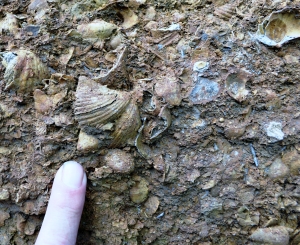
Now, take a good look at the various strata. Some are not very exciting, just dull gray rock. But other horizons are enormously fossiliferous. You will quickly find beds of limestone which, upon careful viewing, appear to be all broken shells. Some of these beds are just a complete hash of shells. They have lost their original bright colors, but they are still shells.


These are invertebrates, mostly forms called brachiopods. Like modern clams, they had two shells, but that’s all the similarity that the two groups share. Brachiopods are not mollusks; they belong to a wholly different category of invertebrate. They were very abundant back in the Devonian and made up the dominant form of sea life here.

We are the mind’s eye; we have waved our arms through the air, and traveled back into time, all the way to the early Devonian. We find ourselves adrift on the surface of the Helderberg Sea. All around us, in every direction, an empty and endless sea stretches out to the horizon. There is no land to be seen anywhere. The waters are aqua in color, that’s typical of a tropical sea. And that is exactly what the Glenerie Sea is. We feel the water temperature and it is a balmy 82 degrees.

Below us, the sea is so shallow that we can see the bottom. There are active currents and that has swept much of the seafloor clean. We see a lot of pink, very coarse sand drifting and shifting back and forth as waves sweep across the bottom. There are a lot of broken shells down there, most all of them are from brachiopods; they have suffered during common storm events and have come to be broken up into a colorful hash. We look around but do not see and living brachiopods. That’s just bad luck; we picked the wrong moment to visit the Glenerie.

It is an exhilarating experience to travel through time like this. It is such a privilege to see the distant past. But the main point is that this bas been a Darwinian journey to a very ancient world populated by very different creatures from those of today. Such visits are always all too brief. In a blink of the eye, we are back on Rte. 9G. It is winter in Ulster County. The highway is dirty with grit and salt; the outcrop is dirty and drips with icicles.

Next time: the stagnant sea.

Contact the authors at randjtitus@prodigy.net. Join their facebook page “The Catskill Geologist.”
A high impact event Oct 14, 2021

in Uncategorized by

A High Impact Event

Stories in Stone; The Columbia County Independent

Updated by Robert and Johanna Titus


Is there anything more emblematic of domestic bliss than a husband and wife trading sections of the morning newspaper over the breakfast table? Well, it’s just a little different when both are scientists. So, it came as no surprise when Johanna, the molecular biologist, handed Robert a copy of the Proceedings of the National Academy of Sciences and asked him if he had read an article in it. He was glad she did as he might well have missed it and the story was a very good one. It led the two of us to envision another of those very rough days that occasionally affect Columbia County, and, at the same time, it may have solved several longstanding geological mysteries.

Geologists have long known of a series of enigmatic crater-like structures, scattered across the eastern coastal plain of North America. They are called the “Carolina Bays.” Elliptical and oriented from the northwest to the southeast, they have long suggested an ancient impact event, but we have never been quite sure. We have also long known of a puzzling thousand-year long cold spell called the Younger Dryas. Then there was the mystery of the extinction of the North American megafauna and the sudden disappearance of the Clovis Indian Culture. Many large mammals, and the Indians that may have hunted them, disappeared, or at least declined abruptly about 13,000 years ago. All these puzzling events may have recently been tied together with a thin seam of dark earth. Read on.

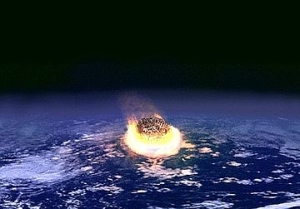
It seems a large team of high-powered scientists had recently described an inch-thick, carbon rich seam of earth that is found at sites across much of the continent. The seam is rich in iridium, magnetic micro-spherules, soot and glass-like, carbon-rich nano-diamonds. The seam, in the many places it has been found, is always dated at just about 12,900 years in age. It has been found at exactly the top of strata containing Clovis points, which is also the same horizon where mammoths and other large fossil mammals disappear. The age of this corresponds to the start of the Younger Dryas cold spell. The seam has been found to pass through a large number of the Carolina Bay craters. It is an incredible find; it ties together all the above-described scientific problems. But what exactly does it tell us?

The word iridium may remind you of the ash deposited by the asteroid which is thought to have wiped out the dinosaurs. If that catches your attention, it should. It sounds like we, all across North America, had our own mini dinosaur extinction event. From the composition and abundance of the impact materials it is estimated that the object was actually a comet, and it was four kilometers across.

If you know much about the turn of the century event in Tunguska, Siberia, then you can envision the story. Here in the Hudson Valley, we would have seen the comet coming in from the northwest at an oblique angle. At some point it exploded and the enormous impact of all this caused the great continental glacier below it (remember, this was still the Ice Age) to largely melt. Vast quantities of meltwater resulted. But the impact was so very hot that, not only did the ice melt, but farther south, vast stretches of forest caught fire. Huge widespread wildfires raged across North America. That’s where all the soot came from. An impact of this sort tosses huge amounts of rock and earth up into the sky. When it comes down, friction sets it ablaze and so even more fires are set. You get the picture.

The result is something that is often called a “nuclear winter” and that gets us to the Younger Dryas cold spell. The dark sooty clouds, generated by the impact initiated a cooling that would last for a full millennium. The extinction of about 30 types of large mammals suddenly has a natural explanation. The Paleo-Indians, it would seem, are off the hook for this crime. But human populations plummeted as well. It must have been a very difficult time for Indians and the Clovis Culture disappeared altogether. All this reminds us, once again, how fragile our existences are.

We wrote this years ago. Sadly, this hypothesis currently seems to be falling out of favor.

Contact the authors at randjtitus@prodigy.net. Join their facebook page “The Catskill Geologist.”


Mt. Merino in the Ice Age Oct. 7, 2021

in Uncategorized by

Visions on an Art Trail past – Mt. Merino

Robert and Johanna Titus

On the Rocks


We have been touring the Hudson River Art Trail, all this year (2010), and today, sadly, we reach the end of our journey. There are 18 stops up and down in the Hudson Valley, with more being added by the trail sponsor, Cedar Grove, the Thomas Cole Historic Site in the Village of Catskill. This is only number nine, but all the others are quite distant. We have to end somewhere, and we choose to make it here. This final visit takes us across the Hudson River and up to the city of Hudson.

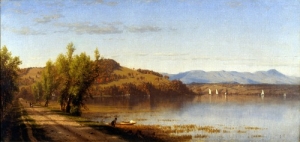
We would like you to go to the Cedar Grove website and navigate to the Art Trail page. Go to the Hudson Valley sites and find stop number nine. It displays an image of Sanford Robinson Gifford’s view of South Bay in Hudson. It was painted in 1864. It’s a pretty scene; the artist was looking across South Bay and toward Mt. Merino. On the left is an old dirt road. It looks to have been an important highway back then. To the distant right Gifford painted the far away Catskill Mountains. He cheated a little to make them look better; he raised them higher than they are. Below the Catskills, a number of sailboats are seen on a very serene Hudson River. To the distant left is Mt. Moreno. Back then the slopes were nearly bare. It was very early autumn and a few trees had just changed color. In the foreground a fisherman is preparing to go out onto South Bay on a small rowboat.

It is a lovely scene, and a very peaceful one; that betrays the fighting going on in Georgia and Virginia on that very day. Gifford knew the scene well; he lived in Hudson and his studio was there. He knew the violence of the Civil War well too; he had served with the Army of the Potomac.

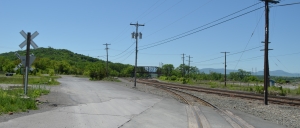
But what does this scene look like today? One of the main purposes of the Hudson River School Art Trail is to allow people to go and see the many locations where these painters worked. We resolved to go and find this site. We crossed the Rip Van Winkle Bridge and headed north on Rte. 9G. We entered Hudson and then started a little exploring. We turned left at Allen Street and left again on South Front Street. About a city block south of the Railroad station we found our destination; it was the very spot where Gifford had worked – 149 years earlier. It wasn’t the same.

????????????????????????????????????

We have marveled, in working on this series, how often the sites our artists sketched were still, today, pristine wildernesses. There are reasons for that. Most of these sites lie within the blue line of the Catskill Park; they have been preserved. But not here; Hudson, during the last century and a half, has endured the rise and fall of all sorts of industries. The scars are there to be seen. In the distance we could still see the Catskills and Mt. Moreno; it was the foreground that had suffered. The old dirt road could still be recognized although it was no longer of much importance. It had, no doubt long ago, been paved. In Gifford’s time it was tree lined; today the trees are all gone. In Gifford’s time the road abutted the very edge of South Bay. Now, running along where the old shoreline was, are railroad tracts. In the distance there is an ugly, black metal bridge. The railroad crosses ground that, back in Gifford’s day, was submerged by the waters of South Bay. That’s where it got so much worse. A great deal of old South Bay had, somewhere along the line, come to be filled in. Today it is a broad flat bare earthen surface baking in the sun. We were guessing that, in the past, this filled-in land must have been used for long forgotten industry.

It gets even worse. We slowly turned a full 360 degrees and surveyed the landscape of a beat up, old, and mostly rundown looking urban center. The last 150 years had seen the rise and, even worse, the fall of industry here. It was inevitable; after all Hudson is a city and cities are supposed to be commercial and industrialized. But it was so sad to see; we can only imagine what Sanford Robinson Gifford would have thought.

In the end, it serves to help a person appreciate the value of the Catskill Park. We can, today, enter the park and see so many landscapes, much as they always have been – still in a nearly natural state. Visiting this part of Hudson is a much more somber experience.

But there is more to the story here; there is an ice age history. The story we saw was surprising. It took us back to the end of the Ice Age. The climate all around the world was warming up. Glaciers were melting and the newly freed waters were raising sea levels everywhere. South Bay is one of many similar embayments along the banks of the Hudson River. When you look at the local topographic map you learn a great deal. South Bay lies at the downstream end of a complex tributary system. It began to submerge as those sea levels rose.

Imagine, long ago, when this stream flowed into an older Hudson River. That was when there were still so many glaciers worldwide that sea levels were lower than they are today. So too, the Hudson River and its tributaries occupied much lower elevations than now. The South Bay creek flowed into that lower Hudson River and carved valleys to that lower level. But then the glaciers melted, and sea levels rose. The Hudson rose too and the lower reaches of the South Bay creek were flooded, first with water and then with sediment. So, melting glaciers and rising sea levels combined to create South Bay and its once very handsome natural landscape. Gifford painted it in a near natural state. We should all be glad that he did.

Our journey along the Art Trail is now completed. It is a series of lessons in art. But we found it to offer lessons in ice age history as well. We have very much enjoyed our journeys and hope that you will follow in our footsteps: and also follow in those of our revered artists.


Contact the authors at randjtitus@prodigy.net. Join our Facebook page “The Catskill Geologist.” .
 

Go to Top