"I will never kick a rock"

Monthly archive

June 2021

The Marcellus gas

in Uncategorized by

A superpool of gas.

On the Rocks, The Woodstock Times July 8, 2008

Updated by Robert and Johanna Titus


Perhaps you have heard the term “Marcellus Shale” and perhaps you have not, but you will likely be hearing about it many times in the upcoming years. New York State geologists have long known the term, and many have visited outcroppings of the dark shale and sandstone that we call the Marcellus. We have written about it occasionally in Woodstock Times columns over the years. The unit of rock has recently become very important.

Late last year (2007), it was announced by several researchers that the Marcellus might well yield an enormous, absolutely gargantuan, amount of natural gas. Estimates are always just estimates, but people are talking about a two-year supply of natural gas being recoverable from the Marcellus. That’s a lot and, given the circumstances, even the greenest of you will appreciate the pressure to exploit this resource.

What can rightfully be called a “gas rush” has been triggered, and all over the northeast quarter of America the search is on. This is bound to be controversial so, before we go too far, let’s get something straight. We are geologist, and one thing we do is to work to keep you from freezing to death in a cave. So, we are not necessarily opposed to all this, but let’s talk about the science of the Marcellus. There is no possible harm in you coming to understanding the geological story that lies beneath your feet.

It all started nearly 400 million years ago when something you might be tempted to call Europe collided with what eventually became North America. You probably, somewhere along the line, learned about plate tectonics. If you remember some of that, then you will understand the following: The plate collision initiated a crustal uplift which, given time, would produce a great mountain range called the Acadians. Our focus is on the early stages of that collision. There were mountains, but they were not yet very tall. Critically, there was also developing a nearby deep oceanic basin. At its maximum it might have been thousands of feet deep. It covered what now makes up much of the northeastern United States.
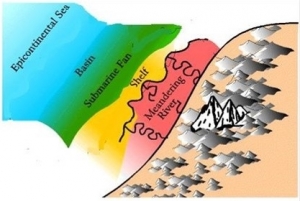
Humans have visited modern versions of such environments. In recent decades we have developed the deep-sea equipment to do so. What was once a great mystery is relatively well known today. It is not the least bit unusual for such a marine basin to be very stagnant. There are few, if any, currents that far down. The rising mountains, nearby to ours, were still so small that they supplied very little sediment to the deep. That’s important.

Raining down from above were bits and pieces of dead organisms and this biological material came to make up a very sizable portion of the Marcellus basin sediment. The abyss was so stagnant that whatever oxygen that might have been there was consumed by microbes. Over long periods of time, the resulting stagnant, anoxic seafloor accumulated, thick sequences of organic rich, fine grained sediment. A lot of the biologic matter became the gas methane and that formed the bulk of the natural gas that would be coveted by humans hundreds of millions of years later.
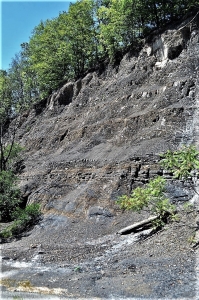
And that is why there is so much interest in the Marcellus. Perhaps you would like to see the unit; it’s not far away. Take Rte. 31 south from Woodstock until you reach the intersection with Rte. 209. Go another 3/4’s mile south and there you will see an enormous outcropping of black shale. This is the Mt. Marion Formation which is an eastern equivalent of the main Marcellus. We found a fair number of fossil shellfish. This does not seem to represent the great stagnant abyss where natural gas would accumulate. So, our guess is that the Mt. Marion will not yield much natural gas, at least not around here.

Farther down the road, near the south end of the outcrop, we found a more finely bedded sequence of black shale. It is made up of very thinly laminated seams of black shale and it displays no fossils. This, we think, is a deeper part of the old basin and it might be that these strata are richer in gas.

If you visit this site, it can be quite an experience, however, to stand along the side of a highway, listen to the traffic, and to realize that this was once the deepest part of the sea. All around you it was once a dark, quiet and cold seafloor. we will have more to say about the Marcellus in future columns; it may be very important geology.

Reach the authors at randjitius@prodigy.net. Join their facebook page “thecatskillgeologist.”
Draining Glacial Lake Woodstock – June 17, 2021

in Uncategorized by

Draining Lake Woodstock

On the Rocks; The Woodstock Times 

Jan. 9, 2009

Updated by Robert and Johanna Titus


We closed last week’s column with a remarkable image. We took you, the readers, west on Tinker Street and then we looked up into the air and saw 280 feet of ice water above us. This was the water of Glacial Lake Woodstock, probably the most important ice age feature in the Woodstock vicinity. We found ourselves at the bottom of this lake with all that ice water above us. That is an astonishing claim.

We left ourselves with the responsibility of proving this notion and today is the day. We would like to not only prove our assertion, but also give you a good example of how we geologists see the landscape as we travel about.  We have a habit of seeing things and noticing things that other people don’t.

Mind you, we usually have to do a lot of exploring before we see these things. Let’s start out west of Bearsville which is also west of Lake Woodstock. On the map there is an interesting pass which hugs the north side of Acorn Hill. You can get there by driving up County Rte. 45, AKA the Wittenberg Road. At the top of the hill is a very inconspicuous bridge.

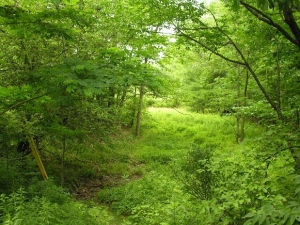
Bridges are supposed to cross rivers or at least creeks and there is a problem here. There is no water beneath the bridge. This is certainly a bit of a curiosity. But the problems get worse quickly. There is a bit of a valley here, a dry one. You can recognize where stream erosion has cut into bedrock and cut a small canyon. Canyon might be overstating it but there definitely used to be a good flow of water here. All this needs explanation!

We are at the far western end of Glacial Lake Woodstock. Our canyon is dry today, but back at the end of the Ice Age there was a powerful flow here. Lake Woodstock was dammed to the east by a great wall of ice, the Hudson Valley Glacier. It was a time when the climate was warming, and the glacier was melting. The waters of Lake Woodstock had to go somewhere, and it was through this canyon that they flowed. Back then these flows entered into the drainage of today’s Little Beaver Kill.

There must have been a very powerful flow of water. Imagine, all of the glaciers in the region ere melting and much of that meltwater was flowing down Little Beaver Kill. It could not have been all that “little” back then!

When we visited the site, we looked and, in our mind’s eye, we saw the ice age torrent. Today, there is no water at all; we climbed down and walked a few yards along the floor of the old stream. We felt the raging whitewater flow passing beneath us. Back then it would have been certain death to jump into this current. But, as geologists, we are lucky; we can experience the best of both worlds and both times.

Now the point of all this is that this dry canyon lies at 880 feet above sea level. The floor of the Saw Kill Valley is at just about 600 feet. The difference, 280 feet is the depth of the old lake. It was a very deep lake.

The great physicists and mathematicians of the world are often still in their 20’s. Geology is different; it is an experiential science. Its best practitioners are not young hot shots, just out of graduate school. They are, like us, the seasoned veterans who have put in decades of work and are able to recognize features in the landscapes around them. You spend a lifetime absorbing your science and then you see it all around. Believe us, we see the world differently than most.

If you get a chance, please travel up Rte. 45 and see the inconspicuous little bridge. Your mind’s eye is just as good as ours. This is your chance to go back and see the Ice Age.

Contact the authors at randjtitus@prodigy.net. Join their facebook page “The Catskill Geologist.”

Glacial Lake Woodstock – June 10, 2021

in Uncategorized by

A cold bath for Woodstock

The Woodstock Times; On the Rocks; Dec 11, 2008

Updated by Robert and Johanna Titus


We have, off and on, over the past year or so (2008-2009), been journeying through Woodstock’s ice age history. In this column we would like to slow down a little and try to focus on one of the more interesting aspects of this saga: the story of Glacial Lake Woodstock.

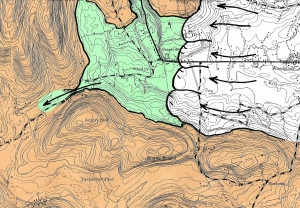
Lake Woodstock was first discovered during the middle 1980’s. It was described, briefly, in a State Museum report, but not much work has been done on it. To date, it has only been recognized as a relatively small lake, mostly just to the east of today’s town. It was, we think, much bigger than that. we have been poking around the area and we are now convinced that the lake stretched all the way to Bearsville. It deserves a lot more investigation than it has gotten. Let’s do some of that today.

We have, in an earlier column, claimed that most of the area west of Woodstock formed on the bottom of the lake, and if you travel west down Tinker Street and look to your left and right, you will see the old lake floor as an extensive flat landscape. But there is more, much more. In fact, this all gets to be very interesting to a geologist.

Our descriptions so far, have been of the first Lake Woodstock. There was a second one and that is where we want to take you today. That first Lake Woodstock formed when a glacier, lying just to the east of town, was damming the Saw Kill Valley. The ice dam blocked the flow of the Saw Kill and that created the lake: the first time.

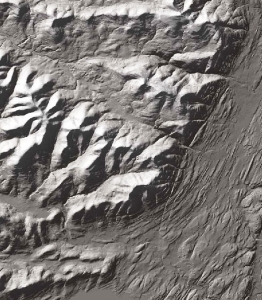
The climate warmed and the glacier retreated back to the northeast and there is a good chance that the first Lake Woodstock drained off to the south. But the Ice Age was a very complex time; its climate was constantly shifting. Under such circumstances a warm period with melting can be replaced by another cold period with a re-advance of the ice. That is what happened. Take a look at the satellite shot. If you view it carefully you will see that the landscape has a streamlined look to it. That streamlining was sculpted by the re-advancing ice. You can actually “read’ the movement of the ice.  It advanced out of the Hudson Valley, from the upper right-hand side of the photo, and pushed on westward. we are not sure how far it got, but we can see streamlining at least as far as west of Bearsville. That means that much of the Saw Kill Valley was, once again, filled up with ice. In fact, when we look at this image, we can convince ourselves that the hills, south of Woodstock are smoothed off and streamlined, more than is the case for the taller Overlook Mountain, to the north. We are guessing that the ice actually overran those southern hills. It seems to have been a major advance of the ice.

We wonder how long such an event takes, but we will never know. And we wonder how long the ice remained, clogging the Saw Kill Valley. we will never know that either. But, given enough time, the climate warmed and the ice retreated from the Saw Kill, one final time. Once again, the remaining ice formed a dam, and that dam blocked the Saw Kill and created the second Glacial Lake Woodstock.

Take another good look at that satellite shot and you will see the flat landscape in the Bearsville area and again, just south of Woodstock. There is still more flat landscape in the area east of Plochman Road. All these landscapes are the floor of Glacial Lake Woodstock. It was pretty big.

One logical question is how deep was it? we alluded to that in a column earlier in the year. we believe, that in the Bearsville vicinity, this lake was at least 280 feet deep. If you are reading this somewhere near Tinker Street, we would like you to look out the window and up those 280 feet and “see” the ice water here. Once again geology has a way of rearranging your sense of reality.  Carl Sagan had something to say about notions such as this. He said that “extraordinary claims require extraordinary evidence.” Providing the evidence for the 280-foot claim will be our responsibility in the next column.

Contact the authors at randjtitusr@prodigy.net. Join their facebook page “The Catskill Geologist.”


I heard that crack – June 3, 2021

in Uncategorized by

“I heard that crack!”

On the Rocks – The Woodstock Times – June 18, 2021

Updated by Robert and Johanna Titus


Being a scientist means that you are going to end up knowing a lot of smart people and I no exceptions to that rule. But we have only ever known a handful of geniuses. One of those is our friend, photographer Vincent Bilotta, who lives in Palenville and works throughout the Catskills. It is hard to define real genius, but you know it when you encounter it. Take a look at some of his photos and you will see.

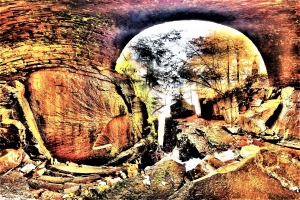
We had, for years, been trying to take a picture of a geological feature that lies beneath the stone bridge at the top of Plattekill Clove. That’s at a gorge called Devil’s Kitchen, which is one of the most scenic parts of this very scenic clove. It’s dark down there, underneath the bridge, and we just never could get a good picture. Vincent, the genius, not only took a good photo but he produced a great one. He has kindly let me use his image to illustrate today’s column.

The feature we are speaking of is seen left of center in the photo. Take a look and see the structure that looks like a gigantic, petrified bird feather. It’s three or four feet across so don’t worry, no bird produced this. It is what structural geologists, logically enough, call a “plumose structure” and it has quite a story behind it.

The rock it is seen upon is Devonian in age; it is about 380 million years old. It is sandstone and probably its sand was deposited in the channel of a Devonian river. It hardened into rock and subsequently it became involved in one of the great mountain building events in Earth history. That would be the Acadian Orogeny, an event that produced an early version of the Appalachians, called the Acadian Mountains. The rocks we see here were involved in the uplift. They once lay deep within the bowels of those ancient mountains. There were subjected, back then, to truly intense pressures. The rocks you are looking at were, for a long time, buried under a mile or more of bedrock. Imagine the pressure that produced!

Our rocks were squeezed by all that pressure. It is difficult to imagine rocks being compressed but that really can happen. Typically, rocks have a good deal of “give” to them and they can absorb the stress, pretty well. It is much later that they encounter trouble.

The mountain building event we are talking about involved a great landmass, called Avalonia, colliding with North America. That is where the compression came from. It only got worse, later on, when also Africa collided with North America. Mountain building collisions, however, only last so long. Eventually, what happened is that the collision ended, and, in fact, a breakup of the land masses occurred. Africa drifted back to the east toward where it is today. That released all the pressure that had compressed our rocks.

In this new relaxed state of affairs these rocks began to expand back to their original state. That’s when they became brittle, and that’s when the fracturing occurred. You see, a plumose structure is a special type of crack. Essentially, the fracturing begins at the base of the “feather” and expands away from that point. As the fissuring “ripples” through the rock it creates the plumose pattern. Take a good look at the photo, or better yet, go to the bridge at Devil’s Kitchen and see the real thing. You can easily imagine the fracturing passing through the rock.

This was an exciting moment; things happened fast. Some geologists think that the fracturing occurs at something that approaches the speed of sound! And it must have made a lot of noise too; we would imagine a very loud pop or snap. The surface that the plumose structure is on is a flat, nearly vertical plane. That is another aspect of the fracturing. We call such a fracture plane a joint; it is a special type of crack.

All this amounts to another of those most remarkable features, so often found in the rocks. This was not just a little bit of deformation; this must have been a real earth thumping event. For all practical purposes this is a petrified earthquake. Think about that for a moment. You can actually preserve the evidence of an ancient earthquake in the rocks!

And photograph it.

Contact the authors at randjtitus@prodigy.net. Join their facebook page The Catskill Geologist.”


Go to Top