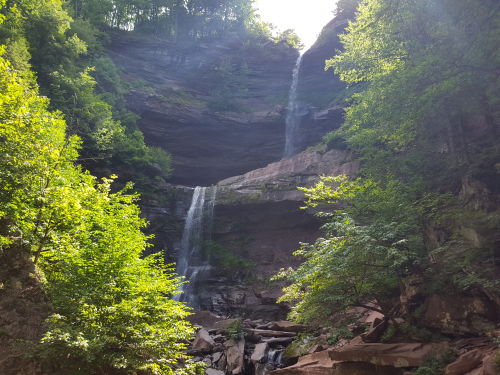
"I will never kick a rock"

Monthly archive

May 2019

The Glaciers got here first May 30, 2019

in Uncategorized by

The glaciers got there first
The Catskill Geologists
Robert and Johanna Titus

Have you been to the Walkway across the Hudson at Poughkeepsie? It’s a pedestrian bridge that, high up in the sky, crosses the river; We promise you, it’s quite the experience. But, opening next week, is something just as good and a lot closer. That’s the Hudson River Skywalk. The Skywalk also spans the Hudson, this time across the Rip Van Winkle Bridge. In so doing, it links two important historic sites: Frederic Church’s onetime home, Olana, and Cedar Grove, the Thomas Cole Historic Site. The new trail extends from Cedar Grove, across the bridge. and then it ascends the hill to Olana. Can there be a “theme’ to a walkway? If so, with this one it’s the Hudson River School of Art. Cole and Church were that “School’s” two leading lights.
We said that the Skywalk was just as good as the Walkway, but maybe we can write about something that makes it even better. If you get a chance and you head out over the Hudson, we would like you to look and see how steep the slopes are on either side. We are talking about the slope just beneath the western end of the bridge and the other slope just beneath Olana. That steepness is something that is not always easy to take notice of, but it is important. Shouldn’t there be a floodplain? Rivers are supposed to flow across broad, flat floodplains, aren’t they? So, why not here?
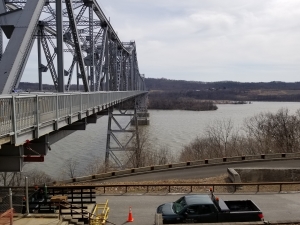

The Skywalk – 

We got to thinking about that and came up with an answer, a good geological answer. Halfway across the bridge we looked east and west and then north. In our mind’s eyes we saw a glacier. It was perhaps 14,000 years ago and, for the most recent time, an ice age glacier was advancing down the Hudson Valley. That glacier rubbed up against the slopes on both sides of the river. Glaciers can be very erosive and this one was no exception. It cut into Church Hill where Olana is perched. That would greatly improve the view that Frederic Church would eventually paint. It also cut into the western side of the river. All this erosion left no room for any kind of floodplain. Instead, it formed a rather boxy valley with a sizable river flowing down a surprisingly narrow pathway. You probably never noticed this, did you? Well, go out onto the Skyway and take a look.
The official opening is set for June 1st. People will congregate at Olana and at Cedar Grove. Each group will set out on a “parade” to the Skywalk Trail. If all goes well, they will all meet at the middle of the bridge. There will be a ribbon cutting at the park near the bridge’s toll plaza at noon. We don’t think there will be a golden spike, but it should be a fun event.
Plans may change so before going, you should contact Cedar Grove at thomascole.org or Olana at olana.org. Contact the authors at randjtitus@prodigy.net.

Go to the Olana or Cedar Grove websites for details. 

A red sunset May 23, 2019

in Uncategorized by

A red sunset
Windows Through Time
Register Star
Johanna and Robert Titus
June 4, 2014

We are guessing you have seen an image of “The Scream,” a very famous and much stolen painting by Norwegian impressionist artist Edvard Munch. There were actually four versions, painted between 1893 and 1910. Our favorite is the 1895 one. It’s the contorted face that catches everyone’s attention. Right behind this unhappy figure is a dock jutting out into a Norwegian fjord with a sailing ship in the distance. But, if you have an alert eye, there is the background; it’s the sky that’s interesting. Munch paints a striking vision of horizons of orange sky, mixed with thinner levels of blue and yellow. Once you take note of it, the sky is just as alarming as the rest of the painting. It’s truly great impressionist art.

We have been frequently guilty of slipping art into our columns, but how on earth have we managed to get Munch’s painting in here? The answer involves some of the professional debate that has swirled for decades over the colorful sky in the scream paintings. Many art historians have argued that Munch had experienced the orange sunsets that occurred all around the world for months after the eruption of the south Pacific volcano Krakatoa in 1883. Volcanic ash erupted from the volcano, drifted high into the sky and circulated around the world. Sunsets were a brilliant orange for quite some time and any number of landscape artists painted them.
That gets us back to some work done by famed artists Thomas Cole and Frederic Church. Cole was the master painter of the Hudson River School of landscape art. Frederic Church became his student in 1844 and 1845. He would follow in Cole’s footsteps and ascend to be the most successful member of the Hudson River School.
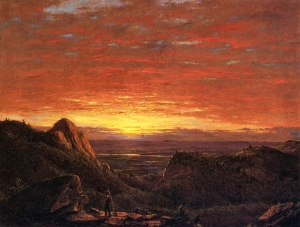
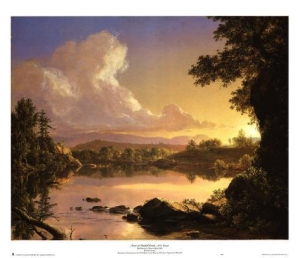
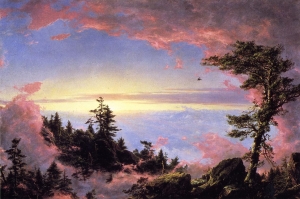
The Thomas Cole house mounts an art exhibit every summer; we never miss one This year’s (2014) paintings were almost all done during, or soon after, the two years of Church’s residency in Catskill. But we noticed something about the paintings done from 1847 to 1849. Those images were far more likely to have bright red sunsets (or sunrises) than others done earlier or later. Church found inspiration in the rising and falling sun. Sometimes it shined right up onto the undersides of the clouds. At other times descending lobes of clouds could be painted in fiery reds while other parts of those same clouds, hidden from the sunlight, would be painted in a variety of dark grays. Interspersed, would be occasional horizons of blue. This gave Church an interesting visual theme to explore. This play of light and color in landscape art is called luminism.
We are including several paintings from the exhibit. First, we ask you to take a good look at Morning, Looking East over the Hudson Valley from the Catskill Mountains, 1848. It has the rich play of colors we are talking about. Also, take a good look at Scene on Catskill Creek, 1847. Although not as red, it shows a brilliant setting sun. Now, look at Church’s Above the clouds at sunrise, 1849. We see, once again, the same play of colors.

     
We were familiar with the debate about The Scream and we began to wonder about Frederic Church’s paintings. Why did he paint such vivid skies from 1847 to 1849? Was it just his artistic imagination at work or was there something else? We are not art historians; we are practicing geologists. As such, could we find interesting scientific insights to help understand these paintings? We went to work. Scientists follow the scientific method. First, we find problems that need solving; then we develop hypotheses that might offer solutions to these problems. Let’s call our hypothesis “the scream hypothesis;” we argue that bright orange and red landscape paintings are associated with great volcanic eruptions. Scientists “test” their hypotheses by making observations, finding the facts behind them. We looked at history.
We found that there were five eruptions during 1846, four of them in November alone. In May the volcano Tangkuban Perahu, in Java, erupted. Then, in November, there were eruptions in Chile and Japan, then two more in the Cascade Mountains of our Pacific Northwest: Mt. Baker and Mt St. Helens.
All in all, it appears that as the year 1847 began, there must have been a lot of volcanic ash in the skies and they were likely spreading all over the globe. So, our hypothesis is that Frederic Church was influenced by volcanic ash in the skies when he was painting at that time. That hypothesis looks very plausible.
Contact the authors at randjtitus@prodigy.net. Join their facebook page “The Catskill Geologist.:

Plattekill Clove May 17, 2019

in Uncategorized by

Devil’s Advocate
On the Rocks
Woodstock Times
Updated by Robert and Johanna Titus

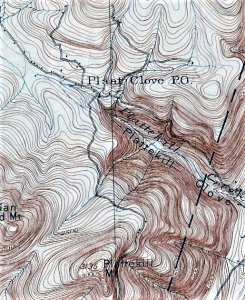
Plattekill Clove is one of those out of the way Catskill canyons. The land is mostly open to the public now and there are few private residences. Take the West Saugerties Road to West Saugerties itself. Turn left onto Platte Clove Road which is also Rte. 16. This is the one road that ascends the clove. It is a narrow one and it isn’t open in the winter. Even in the warm months, however, you can hike up the road and not worry about too much traffic bothering you. There are several nice scenic viewpoints along the way and it’s well worth the effort to get to know this lovely location.
To us, it is the top of the clove that is most interesting. There is a remarkable stream pattern to be seen there. Plattekill Creek forms itself up there. Several small tributary streams descend the slopes of the eastern Catskills and combine to create the creek. None of them is of particular note, they’re just run-of-the-mill mountain streams. But even if these streams are of little note, what happens to them is
.
Plattekill Creek is a young stream. It probably dates back no further than the ice age. Before the glaciers flowed down the Hudson Valley there probably was no Plattekill Creek. But when the ice came it seems to have sheared off the eastern ledges of rock and created the great, steep “Wall of Manitou” that towers above the Hudson. The steep slope was, quite naturally enough, attacked by newly formed streams. Rivers flow rapidly down steep slopes and they cut deeply into them. That’s what produces cloves such as the Plattekill.
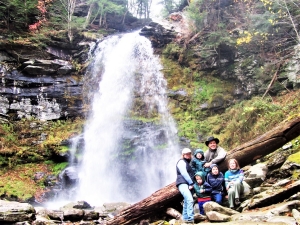
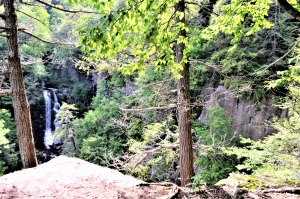
The best part of the clove is near its top, a location known as the “Devil’s Kitchen.” The Catskill Center for Conservation and Development has acquired much of the land here, and the public is welcome to visit this site. The center owns a tiny red cabin at the top of the clove. Those two streams we mentioned reach a confluence just above the cabin. The confluence is of no particular note, but just downstream the combined flow drops off a fine waterfall. Here the erosion of Plattekill Creek has reached up into the mountain and cut the falls.

To see the waterfall, you can follow the trail that starts next to the cabin and descends a short distance down the clove, curves back and brings you to the base of the falls. From the base of the falls you can turn around and look down the valley. This is real good youthful stream morphology. The canyon is narrow and deep. It is the product of very rapid and very recent erosion. The Catskill Center welcomes you, but they would like it very much if you would stay on the marked trail.
A quarter mile farther down the road another small mountain stream descends from the north and enters the Plattekill Creek. This erosive stream has been a very active itself. It has cut the most remarkably narrow and deep chasm into the bedrock. The work “defile” is sometimes used for a landscape feature of this sort, and it’s just the right word. This cut in the slopes is on private property, but you will have no trouble seeing it from the side of the road.

The falls at the upper Plattekill Clove is one of the most graphic demonstrations of the erosive power of a mountain stream that we know of in the area. This kind of creek devotes itself to what is called downcutting. Erosion is focused on the removal of rock beneath the stream bed. Virtually no widening of the valley has yet occurred. It is the earliest stage in the development of a mountain creek’s valley. The flow of water exploits the fracture patterns that are here and removes blocks of rock from between the fractures, one at a time. Eventually the defile is produced. Spring is the time of the year to see this process in action. The Devil’s Kitchen won’t last for long (in terms of geological time), a couple of hundred centuries pass by and bingo – the canyon is gone! So, enjoy it now, while you still can.
Contact the authors at randjtitus@prodigy.net. Join their facebook page “The Catskill Geologist.”

A moraine at Cooperstown May 9, 2019

in Uncategorized by

A Line Drawn in the Sand
The Cooperstown Geologist
Updated by Robert and Johanna Titus
March 2007

A geologist is privileged to see the world differently from other people. That’s not arrogance; that’s just the product of a lot of experience in our science. We would like to prove this by taking you up a road you have probably traveled many times. On our trip I would like to show you what I see; it may change your perceptions.
Head south from Cooperstown on Rte. 28 until you reach County Rte. 26 and turn right (west). Drive to the top of the hill and park (safely; it is a busy highway). Across the road on the south side is a wonderful panoramic view of the upper Susquehanna. It is also a panoramic view of the Ice Age.


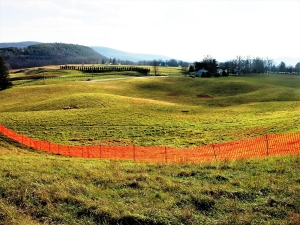
Right in front of you is a series of pretty little rolling hillocks. They rise and fall like waves upon a roiling ocean, but these “waves” are much more smoothed out than those of an ocean. Use the words sinuous or sinuosity to describe this land. Is this view just something pretty, or is there more?
There’s more. We geologists look at these forms and call them kames and kettles. The kames are the sinuous rises while the kettles are the sinuous depressions. How did they get there and what do they have to do with the Ice Age? Turn around and look.
North of the road today is a farmstead, but in our mind’s eye we look and we see a glacier. A big dirty, wet pile of glacial ice lies right where the farm should be. It is melting and melting rapidly. Boulders, cobbles and earth are tumbling out of the dirty ice. Thundering flows of turbid water are cascading off the glacier and streams of agitated meltwater are flowing to the south.
Turn around again and look south. The turning may make you dizzy but the travel through time makes it worse. We are now in the year 12,356 BC and before us is another, more barren vision of an ice age Cooperstown. In the distance, just east of and across today’s Rte. 28, lies a glistening plain of soggy wet sediment. It’s the freshly deposited sediment that was washed out by those meltwater streams. Those creeks have broken up into a braiding of crisscrossing rivulets and it is these that have been spreading the sediment across that flat plain.
But now gaze immediately to our front. We see those sinuous hillocks again, but now stripped of their modern grasses; it is a freshly formed kame and kettle landscape. The kames are wet heaps of sand and gravel. There are a lot of boulders in them and some of them are enormous. It’s the kettles that tell much of the story. At the bottom of each is a mass of dirty ice. Those are “the tips of ice bergs.” It seems that each kettle formed where a large broken chunk of glacier had gotten itself buried. The climate has been warming and those masses of buried ice have been slowly melting. As they have done so the land above them has collapsed into those pretty sinuosities we call kettles.
We slowly become aware of what has taken place here. From behind us a great glacier has advanced down the Susquehanna Valley. It reached today’s Rte. 26 and there it came to a halt. Briefly the forces that drive the glacier forward were exactly balanced by the processes of melting. Boulders, cobbles and sandy gravel were brought to the front of the ice and dumped just south of today’s Rte. 26. It’s something geologists call a glacial moraine. The melting glacier provided the streams of water that carried much of the sediment beyond the moraine and deposited it on that plain we see across Rte. 28. Geologists call this an outwash deposit; it is a good name.
The whole assemblage of landforms is called a “moraine-outwash complex” and in our mind’s eye it provides a fascinating vision of the past. But don’t just read about it, bring this column to Rte. 26 and stand atop the hill and read it again with the landscape right in front of you. We told you, we geologists see the landscape differently from others and here is the place to learn that.

Contact the authors at randjtitus@prodigy.net. Join their facebook page “The Catskill Geologist.”

Pillow talk

in Uncategorized by

Pillow Talk
On the Rocks
The Woodstock Times
June 3, 1999
Updated by Robert and Johanna Titus

There is something naturally mysterious about the bottom of the sea. Sea floors are dark, hidden and nearly impossible to get to, so of course they are shrouded in a captivating sort of mystery. But if the bottom of the sea is a puzzle, what about under the bottom of the sea? Who can even guess what goes on beneath the surface of masses of soft sediment lying buried at the bottom of the sea? Nobody, we suppose, and you would wonder who would even care. But things do happen down there and sometimes we geologists get to see the results, left as impressions in the sedimentary rocks. The rocks show deformations which occurred while they were still soft, wet sediments. What caused these deformations? That’s the job of a sedimentologist to figure out. Mind you, we are not trying to build up some great, enormous mystery here. Nothing supernatural lurks down there. In fact, nothing even all that interesting goes on within the sediments. We are just suggesting that, under the pressure of great weight, things happen to soft wet sediment and it’s the nature of we geologists to try to understand what it is.
The problem comes to light where weathering and erosion have cut into sedimentary rock. Road building also does a fine job of slicing cross sections into outcrops and exposing their interesting structures, including the results of deformational processes. We found a good example recently along Rte. 212 at its intersection with Centerville Church Road. Here, long ago, road building cut a number of excellent outcrops, exposing fine cross-sectional views of sedimentary rocks. The rocks belong to the Hamilton Group. They are strata of marine sandstones and shales that were deposited at the bottom of the Catskill Sea during the Devonian time period, nearly 400 million years ago. At the time of deposition these sediments were nothing special, just sands and muds. Today they are still nothing all that special. We looked to see if there were any fossils but found none. There were no special sedimentary structures either, no channel forms, no ripple marks or even the cross bedding of strong currents. It was, for the most part, just a routine outcrop.
  Typical ball and pillar structure

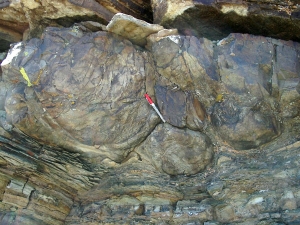
But then something caught our eyes: immediately across the road from a yellow right turn sign we found something called a ball and pillow structure. It’s a mass of sandstone that had become very dramatically deformed while it was still wet. The wet sand had somehow become disturbed and sunk, or foundered into softer muds below, forming a large round-bottomed mass. Because of its rounded structure it has earned its ball and pillow name. Naming something like this is easy, but how did it get here? We can look at these structures all we want to, but we will never figure out exactly how they formed. Rock is sediment “frozen” solid and we cannot replicate the original dynamics. Some sedimentologists, however, have tried to deal with this problem by experimenting with masses of sediment in laboratory tanks and they have duplicated this structure by passing shock waves through them. In nature the best way to induce shock waves in sediments is to have an earthquake. So, are these “fossil earthquakes?” we don’t think anyone knows. But, that’s the way we are betting.

Ball and pillow structures are quite common throughout the Hamilton sandstones. We have seen many of them in many locations. But most of them are rather small; the diameters of the pillows are only a foot or so across. But some are very large and the one on Rte. 212 is about as big as we have ever seen, being three feet, or so, across.

So, once again, we encounter one of those oddities of the rock record, by itself nothing all that special. Some days a geologist finds wonderful things; other days are far more mundane: This is pretty so-so stuff. But spotting ball and pillow structures is all part of that art we like to call “rockcraft.” Maybe ball and pillow structures aren’t all that important, but it is better to know about them than not to.
+++++++++++++++++++++++++++++++++++++++++++++++++++++++++++++++++++
Contact the authors at randjtitus@prodigy.net. Join their facebook page “The Catskill Geologist.”

Go to Top