"I will never kick a rock"

Monthly archive

May 2024

Glaciers at Pratt Rock – May 14, 2019

in Uncategorized by

A glacier at Pratt Rock

The Catskill Geologists; The Mountain Eagle May 14, 2019

Robert and Johanna Titus


We were happy to read in the Mountain Eagle of plans for the upcoming restoration of Pratt’s Rock. It’s quite an unusual location; it’s been there a long time and does need an upgrade. We look forward to seeing what will happen, and we hope, when things are done, there will be some appreciation for the geological heritage of this fascinating site.

Had all gone to plan then Zadock Pratt would have had quite the Mausoleum up there, but that did not happen. Nevertheless, Pratt does still have a most impressive monument. Probably most all of you have visited it. Many of you have climbed up and seen closeup the carvings that are there. There is still a chamber where Pratt planned to be buried. Then there is the poignant image of Pratt’s son George who died at the Civil War’s Second Battle of Bull Run.

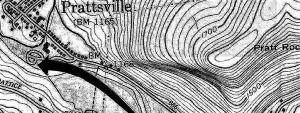
None of this would have or could have been if there had not been such a steep slope there to begin within. Take a look at our first illustration; it shows a topographic map of Pratt’s Rock. Can you “read” contour lines? Then you will recognize the steep Pratt Rock slope from the closely spaced contours. It’s nearly a cliff and it faces the valley of Schoharie Creek which flows through Prattsville. Ledges of Catskill sandstone tower above the valley. A ledge is just a ledge, isn’t it? Well, not where we come from; we are geologists and we know there is a deeper story here
We hike up to the carvings and then continue onwards to a ledge that offers a fine view of the valley. See our second illustration, a photo of that ledge. Notice the smooth surface and the sharp drop-off of the ledge; there is a cliff there. Less obvious, but quite important, are the scratches on that surface. There is a lot of ice age history here. We look and we see what is called the Schoharie Creek glacier passing by. It has flowed south, swelled up to fill the valley and passed across this sandstone. The ice carried a lot of sand with it, mostly concentrated at its dirty bottom. That sand acted as sandpaper and produced the flat surface. There was more, the glacier carried cobbles and boulders along with the sand. They were dragged across this surface and that produced those scratches which geologists call striations. Knowing this, now you can see that they parallel the glacier’s movement down the valley.
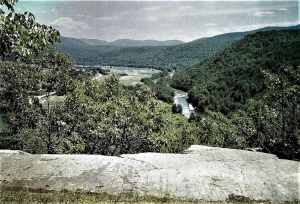
What about that cliff? That’s all part of the same story. Glaciers can be sticky. A glacier, when it passes across a mass of rock such as this, forms a tight bond with it. The glacier continues its journey south, it exerts a tug upon that rock. It is quite possible that the tug will break loose a mass of rock and yank it loose. That’s what happened here. There is nothing unusual about this; we geologists see such things frequently. It has a name; we call it glacial plucking. We stand at the top of this cliff, look down the valley and know that somewhere down there is all that missing rock, buried in the floodplain.

Well, the story we have just related, goes a long way to explain how it was that Pratt’s Rock came to be. It started out as an ice age feature. But there is a lot more to this story. Let’s continue next week.

Contact the authors at randjtitus@prodigy.net. Join their facebook page “The Catskill Geologist.” Read their blog at “thecatskillgeologist.com.”
A Summer Hike with the Mountain Top Historical Society. 5-24-24

in Uncategorized by

A hike to South Mountain

The Catskill Geologists; The Mountain Eagle, June 7, 2019

Robert and Johanna Titus            


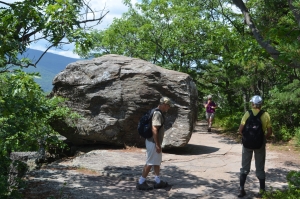
The hiking season has arrived for the Mountain Top Historical Society (2019). The two of us have been members for decades and have long enjoyed going exploring with them. On Saturday, that’s tomorrow, renowned hiker Bob Gildersleeve will be leading a trek to the edge of the Catskill Front at South Mountain. That’s a remarkably scenic location that rises above Kaaterskill Clove and overlooks the vast expanse of the Hudson Valley.

It looks like most of the hike will be on or near the Blue Trail. That path rises up the slope just south of the old Catskill Mountain House Hotel site. That will take the hike up a slope that was carved by the glaciers of the Hudson Valley glacier. Participants can expect to see views of the valley from the tops of sizable cliffs. Today’s scenery is spectacular but try looking at the alley and see it filled with ice! That was perhaps 16,000 years ago.

The Blue trail will pass by ledges of rock called the Twilight Park conglomerate. That’s a thick mass of petrified gravel and cobbles. It will take us another 380 million years into the past. You look at the strata to the west of the trail, and then turn to the east. Now, rising high above you, towers the image of an enormous and ancient mountain range, the Acadian Mountains. Those cobbles and gravels formed as a mass of sediment, that was transported down the old mountain slopes, mostly by gravity. That range is nearly gone. Only the Taconic Mountains, across the valley, remain as remnants of what once were colossal mountains, rising between 15 and 30 thousand feet above the eastern horizon.

The trail and its environs are littered with enormous boulders, most of them left behind by the actions of glaciers. Does Druid Rack sound interesting? How about Boot Jack rock or Sphinx Rock? They are all there, near or along the trail. For the most part, they were yanked out of the ground by passing glaciers and then dragged to where we see them today.

This is a classic trek; it’s been a tourist destination for generations. People have been hiking these pathways since the early 19th century. Visitors to the old hotels enjoyed these trails. Countless postcards were made here. We remember our first visit and the impact it had on us. Have you been? If not, then you should not miss this hike; you will not forget it.

Contact the authors at randjtitus@prodigy.net. Join their facebook page “The Catskill Geologist.” Read their blogs at “thecatskillgeologist.com.”


Looking into the future. May 16, 2024

in Uncategorized by

Looking into the future

The Catskill Geologists

Robert and Johanna Titus


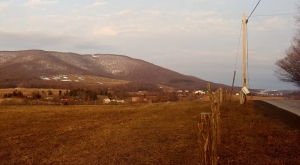
We frequently travel about in the Catskills, and we are always on the lookout to find a new topic for one of our columns. One day, recently, we were approaching Mt. Utsayantha from the northeast on County Rte. 14. On the mountain’s slope, rising in front of us, we noticed a fairly nondescript mountainside feature. Take a look at the left center part of our photo. You will see what is sometimes called a niche. That is, there is a depression in the side of the mountain.

Well, “so what,” you might ask, “big deal, what is there to get excited about?” And you would be right; this is not an especially big deal; it is indeed just a depression in the slope. But we are geologists, and we are writers. We are always looking for an angle. After all, we have to send off a column almost every week.

We started taking this image and projecting it into the future, of course we mean the distant geological future. What, we wondered, would happen if another ice age came along? Our niche in the mountain would soon fill up with snow. And that would initiate a sequence of very predictable events, typical of the latest chapter of an ice age.

First that niche would accumulate thicker and ever thicker amounts of snow. Then the thickening snows, under the influence of their own weight, would start compacting. The snow would be squeezed down into a material that would resemble the packed snow of a snowball. Geologists call that material “neve”. But the process would not stop there; the compacting would continue until the neve’ would harden into genuine ice.

Once enough ice accumulated in the Mt. Utsayantha niche, it would start to become dynamic. Ice can flow like a great rigid mass of water. Its flow will be very slow, but it will move. It has become a glacier, in fact it has become an Alpine glacier, at least a future Alpine glacier.

We had slowed down but now, intrigued, we pulled over, got out and stared up at our Alpine glacier. Usually, we gaze into the past but this time we found ourselves looking into the distant future. We had traveled to a time when the Catskills had come to resemble the Alps of today’s Switzerland.

When will this future Switzerland descend upon the Catskills? We don’t know; we haven’t gotten any of the ice age geologists that we know, to commit to a precise prediction. But current ice age theory argues that glaciations occur in cycles that recur about once every 100,000 years. So don’t hold your breath. It gets worse; Alpine glaciers don’t form until late in ice age chapters. After all the ice, everywhere else, has melted away then the cold mountaintops become active and Alpine glaciers form.

That happened in the past. At the end of the last ice age, Alpine Glaciers formed atop the highest peaks of the eastern Catskills. The best example that we know of are found at North Point, near North Lake Campground and to the south at Overlook Mountain. Another very fine Alpine peak is Hunter Mountain.

But why didn’t Mt. Utsayantha develop some Alpine glaciers the last time? It may be that the mountain is just not tall enough. It reaches an elevation of 3,200 feet; the others are just a bit taller. So, sadly, Mt. Utsayantha may not be tall enough the next time. But we can dream.

Contact the authors at randjtitus@prodigy.net. Join their facebook page “The Catskill Geologist.”

Planar Cross Beds May 9, 2024

in Uncategorized by

Something called planar cross beds

The Catskill Geologists; May 18, 2018

Robert and Johanna Titus


We would like to get you to take closer looks at the rocks you find yourself passing by. We do it all the time. When we are out driving, we pass outcrops along the sides of the roads. It takes a very well-trained eye to see anything at 55 miles per hour, but it can be done. If you are like so many of us, then you will find yourself out hiking in the Catskills. That’s when we want to help train your eyes to see what has always been there, right in front of you. Let’s do some of that today.

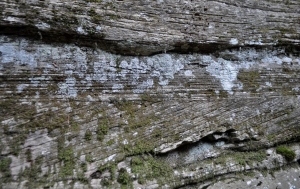
Take a look at our photo; it’s a close-up view of some very typical Catskill strata that we took in the western Catskills. It’s something you might see almost anywhere in our mountains. Notice the structure of the strata. There is an obvious horizontal line running across the photo, starting about halfway up. The strata above that line are all horizontal while those in the lower half are sharply inclined. What is going on here?

We always draw a parallel between what we see in the rocks and what we see on roadside signs in a foreign country. Perhaps you have driven through Quebec and have seen signs written in French. Unless you know French you can’t tell what the sign is trying to say. It’s much the same with the strata of sedimentary rocks. The strata in our photo seem to be trying to speak to you, but you have to be able to read rocks in order to find out what they might be saying.

It must be obvious that the strata in the lower half of our photo are telling a different story from those above them. Indeed they are. We need an English/Rock dictionary, don’t we? On one page would be a photo and on the opposite page would be its translation into English. Well, they don’t publish English/Rock dictionaries so we will just have to get along without one. Let’s give it a try.

The strata on the lower half of this photo display what is called planar cross bedding. Each stratum is inclined to the left and all of them are piled up on top of each other. This records a day in the history of the old Devonian age Catskill Delta. We are at the bottom of a stream that flowed across the delta, perhaps 385 million years ago. There had recently been some sort of a flood event and fast flowing water currents had been carrying a lot of sediment. But that flood event was coming to an end and the currents were slowing down. They were losing speed and losing their ability to transport sediment.

That sediment, most of it being sand, was dropping to the river bottom and forming a dune of sorts. More currents, carrying more sand, rose up over the “dune” and deposited sediment in the form of those left sloping strata. Each represented a moment of deposition. That moment was followed by another and then still another until the whole sequence came be as you see it.

There was a momentary return of high speed flow and that eroded the horizontal line which you will see, cutting across all of the planar cross beds. Normal stream conditions then returned and all of those horizontal strata came to be laid down to complete the sequence. Millions of year passed and those sands hardened, petrifying into sandstone. Then hundreds of millions of years passed and the sequence was exposed by processes of erosion and photographed by us.

Keep an eye out and you too will see things like this

Contact the authors at randjtitus@prodigy.net. Join their facebook page “The Catskill Geologist.” Read their blogs at “thecatskillgeologist.com.”


Tafoni at Prattsville, May 2, 2024

in Uncategorized by

A real geological mystery, and at Pratt’s Rock

The Catskill Geologists, May 31, 2019

Robert and Johanna Titus


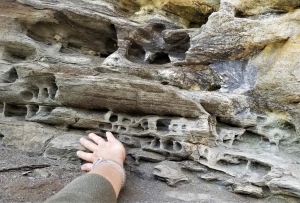
We were invited to speak at the Pratt Museum recently. Our topic was the glacial geology of the Schoharie Creek Valley. After that, a group of us went to Pratt Rock and climbed up the trail there. We took a look at Colonel Pratt’s carvings and continued on to see some nice ice age features. But, along the way, we ran across one of those mysteries we have long struggled with.

We were first alerted to this particular mystery by Paul Misko, a veteran Catskills hiker. Paul told us of some “very strange structures he had found in Phoenicia. Paul has a real eye for unusual geology, so we paid attention to his “very strange” claim. We saw his Phoenician structures and now we have found more of them at Pratt’s Rock. Take a look at our photo and then climb up the steep incline at Pratts Rock and keep an eye out. Towards the top you will find sizable ledges of sandstone. This is rather commonplace stuff: very typical Catskills bluestone ledges. These ledges are, in essence, the cross sections of a very old streams. It’s, like all rocks in the Catskills, Devonian in age, something a bit less than 400 million years old.

None of this surprised us in the least but that’s where we encountered that mystery. Take another look at our photo and see what you think. See the cluster of closely spaced and very strange cavities just above the hand. Their shapes vary considerably, but they all show a sort of boxy nature, and they seem to form an interlocking network. We would like to use the term honeycomb here, but honeycombs show a consistent hexagonal shape; we don’t see that with these. The rock remaining in between these cavities is narrow. The cavities do not penetrate too far into the rock, just a few inches. And there is no reason to think that there is another horizon of these cavities under the ones that are visible. Thus, they appear to be surficial features. Many of these cavities are spaced so close together that they comprise a bigger compound cavity. Whatever it was that formed them was focused.

All in all, this is one of the most puzzling phenomena that we have seen in the Catskills. There is no trouble putting a name on what is here; these structures are called “tafoni.” Each individual cavity is a tafone; lots of them are tafoni. And the terminology keeps getting better; when tafoni occur on cliff faces, as here, then it is called lateral or sidewall tafoni. But putting a name on something is not the same as understanding it.

What are these features? They seem to be chemical weathering phenomena. Somehow, they appeared on the rock surface and grew slowly into their observed shapes, but exactly how? And, also, how is it that they grow in size until they abut each other but do not grow into each other? How do they grow in size without intersecting? Those are very puzzling questions and just naming these things does not provide answers.

Tafoni have been weakly associated with poorly defined stratification on the sides of cliffs and that is the case here: sort of. But that still leaves a lot unsaid. Why does this “association” occur? What are the specifics? Salt is commonly cited as an agent in tafoni development. They are sometimes found on coastal outcroppings, splashed by ocean waves. But there is certainly no source of salt here on a sandstone cliff in Prattsville, and certainly no waves. And why do only a few Catskill Cliffs display these? That begs the question: what exactly is different about his cliff? Why don’t all cliffs have tafoni? Why isn’t it that none of them do? There must be something here, right in front of our eyes, which we have missed. This is the sort of thing that makes science so much fun.

Do you have any ideas or questions? Have you seen tafoni somewhere? Contact the authors at randjtitus@prodigy.net. Join their Facebook page “The Catskill Geologist.”

Go to Top