"I will never kick a rock"

Monthly archive

November 2020

Journey to the Center of the Earth – 11-27-20

in Uncategorized by

Journey to the Center of the Earth, Pt 2

On the Rocks, the Woodstock Times

Nov 12, 1998

Updated by Robert and Johanna Titus


Last week we began a rather remarkable journey into the Earth’s interior. We traveled to the town of Catskill and visited a site that was once possibly miles beneath the surface. We saw beds of stratified rocks there that had been extensively folded by the intense pressures that occur at such depths. But, if a few miles may seem a lot to us, it’s not terribly deep by the standards of the planet. You would have to travel 4,000 miles to get to its center, a mere two or three is hardly anything. So, let’s try to do better this week.

From Woodstock travel across the Kingston-Rhinecliff Bridge. Head east to Rte. 9 and follow it north to Upper Red Hook. County Rte. 56 takes you east to County. Rte. 55 and that runs along the western shore of Spring Lake. We did some exploring at the north end of the lake and we found some fine outcroppings of a rock type we had not seen before in the Catskill-Hudson Valley region.

The roadside outcrops are excellent with very good exposures. As you approach these rocks you will observe that they really are unlike anything else in the area. If you have been visiting the sites we have described in our columns, you will have seen nothing like them. Virtually all of the bedrock in the region is stratified sedimentary rock; the beds are bedded sandstones, shales and limestones for the most part. They were once sediment, deposited in sheets that hardened into strata. But at Spring Lake the rocks are not bedded at all. Instead they are composed of shiny, crenulated masses of very dark rock.

The rock is called phyllite. It belongs to a broader category, commonly called metamorphic rock, and it has had a very long and hard history, even by the tough standards set by rocks. The phyllite here didn’t always look like this. A metamorphic rock, as the name implies, has been metamorphosed, changed in its appearance. It was formed originally as something quite different. It may well have been a sandstone or a shale in the very distant past, but it came to be altered. It was buried under very thick sequences of other sedimentary rock, many thousands of feet or even miles of other rock. Then it was caught up in a great mountain building event.
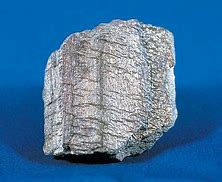
  Phyllite

Metamorphism occurs under such circumstances. The rocks are first subjected to the great pressures that are associated with deep burial. Then too, having sunk to great depths within the Earth’s crust, the rocks enter very hot realms and become, quite literally, baked. Combine the effects of high temperature with high pressure and you get metamorphism. The rocks become contorted and crenulated with the pressure. They become shiny as mica minerals begin to grow within them. That new rock is phyllite.

Surprisingly, phyllite is what is called a very low-grade metamorphic rock. That means things could have been much worse. In the deep interior of this enormous planet, even higher temperatures and pressures are encountered and higher grades of metamorphism are found.

If you look at these outcroppings, you will find a number of seams of course, white crystalline minerals. This is quartz and it probably formed here late in the metamorphic history of the rock. The quartz is interesting but not central to our story.

When did all this happen? The answer is probably during the Devonian time period, during what is called the Acadian Mountain building event. That was one of the three big uplifts that led to the creation of what we call the Appalachian Mountain chain. In effect, then, as we travel to Spring Lake, we enter into the deepest interior of the old Appalachians. No, we have not traveled to the center of the Earth, but we have made quite a very good try at it.

Contact the authors at randjtitus@prodigy.net. Join their facebook page “The Catskill Geologist.”
Tafoni at Pratt’s Rock – Nov 19, 2020

in Uncategorized by

A real geological mystery, and at Pratt’s Rock

The Catskill Geologists

Robert and Johanna Titus


We were invited to speak at the Pratt Museum recently. Our topic was the glacial geology of the Schoharie Creek Valley. After that, a group of us went to Pratt Rock and climbed up the trail there. We took a look at Colonel Pratt’s carvings and continued on to see some nice ice age features. But, along the way, we ran across one of those mysteries we have long struggled with.

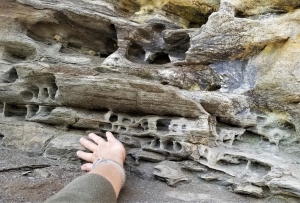
We were first alerted to this particular mystery by Paul Misko, a veteran Catskills hiker. Paul told us of some “very strange structures he had found in Phoenicia. Paul has a real eye for unusual geology, so we paid attention to his “very strange” claim. We saw his Phoenician structures and now we have found more of them at Pratt’s Rock. Take a look at our photo and then climb up the steep incline at Pratts Rock and keep an eye out. Towards the top you will find sizable ledges of sandstone. This is rather commonplace stuff: very typical Catskills bluestone ledges. These ledges are, in essence, the cross sections of a very old streams. It’s, like all rocks in the Catskills, Devonian in age, something a bit less than 400 million years old.

None of this surprised us in the least but that’s where we encountered that mystery. Take another look at our photo and see what you think. See the cluster of closely spaced and very strange cavities just above the hand. Their shapes vary considerably, but they all show a sort of boxy nature and they seem to form an interlocking network. We would like to use the term honeycomb here, but honeycombs show a consistent hexagonal shape; we don’t see that with these. The rock remaining in between these cavities is narrow. The cavities do not penetrate too far into the rock, just a few inches. And there is no reason to think that there is another horizon of these cavities under the ones that are visible. Thus, they appear to be surficial features. Many of these cavities are spaced so close together that they comprise a bigger compound cavity. Whatever it was that formed them was focused.

All in all, this is one of the most puzzling phenomena that we have seen in the Catskills. There is no trouble putting a name on what is here; these structures are called “tafoni.” Each individual cavity is a tafone; lots of them are tafoni. And the terminology keeps getting better; when tafoni occur on cliff faces, as here, then it is called lateral or sidewall tafoni. But, putting a name on something is not the same as understanding it.

What are these features? They seem to be chemical weathering phenomena. Somehow, they appeared on the rock surface and grew slowly into their observed shapes, but exactly how? And, also, how is it that they grow in size until they abut each other but do not grow into each other? How do they grow in size without intersecting? Those are very puzzling questions and just naming these things does not provide answers.

Tafoni have been weakly associated with poorly defined stratification on the sides of cliffs and that is the case here: sort of. But that still leaves a lot unsaid. Why does this “association” occur? What are the specifics? Salt is commonly cited as an agent in tafoni development. They are sometimes found on coastal outcroppings, splashed by ocean waves. But there is certainly no source of salt here on a sandstone cliff in Prattsville, and certainly no waves. And, why do only a few Catskill Cliffs display these? That begs the question: what exactly is different about his cliff? Why don’t all cliffs have tafoni? Why isn’t it that none of them do? There must be something here, right in front of our eyes, which we have missed. This is the sort of thing that makes science so much fun.

   Do you have any ideas or questions? Have you seen tafoni somewhere? Contact the authors at randjtitus@prodigy.net. Join their Facebook page “The Catskill Geologist.” Read their blogs at “thecatskillgeologist.com.”

The Austin Glen Formation 11-12-20

in Uncategorized by

The Austin Glen Formation.

On the Rocks – The Woodstock Times 1998

Updated by Robert and Johanna Titus


The east side of the Hudson River has some very different rocks from those we see around Woodstock. They’re older too and so, of course, they must have different stories to tell. Cross over the Kingston-Rhinecliff Bridge and you won’t have to go far before you see some of these strata. On the north side of the highway (Rt. 199) We found a nice road cut. It was a sequence of dark, thin-bedded shales interbedded with many thick strata of brown and gray sandstone. You are likely to have passed this outcrop many times without taking note of it and we don’t blame you. The unit of rock here is called the Austin Glen Formation and it is certainly not much to look at, gray sandstone alternating with dark shale is hardly picturesque. But to appreciate a unit of rock you have to really understand it and, dull as it looks, the Austin Glen is a most remarkable sequence of strata.

Austin Glen to the right.

There are problems with the unit which, when solved, lead to a fine story. Let’s see. The black shales of the Austin Glen pose little trouble in understanding, or so it would seem. Black shales were once black mud. Such mud accumulated on the quiet floor of a deep ocean and I mean really deep, maybe tens of thousands of feet, a real abyss. So that’s that; the Austin Glen must have formed in the depths of one of the earth’s deepest oceans, or so the shales say. But the sandstones tell a different tale. The sandstones were deposited by fast-flowing currents. we looked and found laminations that are typical of such conditions. And there were also ripple marks preserved in the sands, these are the sculptures of powerful currents. Such currents are most often found in shallow waters. So, the Austin Glen must have formed in a shallow sea, or so the sands say.

So, which is it? Are the shales correct in their tale of deep, quiet waters or are the sandstones closer to the mark? Who’s telling the truth and who is trying to fool us? This is the sort of problem geologists frequently face. Fortunately, this problem had already been solved. Our interpretation of the shales was probably okay, but we must confess that we did get the sands all wrong, at least at first telling.

The sandstone beds of the Austin Glen weren’t deposited by shallow water currents; they were gravity deposits, essentially submarine avalanches. The Austin Glen did indeed, as the shales said, accumulate in very deep, quiet seas. At least they were usually quiet and most of the time the soft muds settled to the bottom of this oceanic basin. But this sea floor was at the bottom of a steep and very deep marine slope. From time to time earthquakes occurred and these triggered the sudden downslope displacement of large amounts of sand, submarine avalanches. We call these “turbidity currents,” and their sandy deposits are called turbidites. Their rapid downward rush slowed near the bottom of the slope and then deposited the laminated and

sometimes rippled sands that we see today.

After each avalanche the sea returned to the slow piling up of more mud. Hence thicknesses of black shale were commonly punctuated by layers of sandstone. In the end the typical Austin Glen strata formed. All this took a very long time and a total of more than 500 feet of Austin Glen strata piled up.

That outcrop, east of the Rhinecliff Bridge, is thus a history, written in rock, of the hit and miss crustal activities of long ago. As we walked along the outcrop we sometimes saw thick sequences of shales; those were the long quiet periods between earthquakes and turbidity currents, when only muds accumulated. There were also a number of thin sandstones, they were turbidites of lessor magnitudes. But then there were also sequences of very thick turbidites laid down in quick succession. We thought about those times; they must have been difficult chapters in our local history, times when powerful earthquakes may have rocked the area, sending great turbidity currents plummeting into the abyss. These were remarkable times, but they would have been forgotten except that they were preserved in the roadside rocks.

Contact the authors at randjtitus@prodigy.net. Join their facebook page “The Catskill Geologist.

Sam’s Point in the Shawangunks Nov. 5, 2020

in Uncategorized by

What’s the Point?

On the Rocks

The Woodstock Times Oct. 14, 2998

Updated by Robert and Johanna Titus


To most people the Shawangunk Mountains are best known for the Mohonk Mountain House or for the hang gliders and rock climbers you will see in abundance on sunny summer Sundays. While the Shawangunks may be a lessor mountain range by world standards, they are still very substantial landscape features in the Hudson Valley. They are geologically distinct from the neighboring Catskills and they have their own story to tell. If you are interested, then a good place to begin to learn the story of the “gunk’s” is at Sam’s Point.


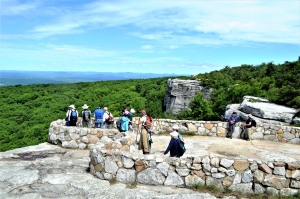
Take Rte. 209 south to Ellenville, then take Rte. 52 east up the west slopes of the Gunks. From there take Cragsmoor Road to Sam’s Point Road and watch for the signs. There is a parking fee. It’s a bit of a trip so allow a whole day. Sam’s Point is the property of the Nature Conservancy. The ice caves are only open seasonally but there are still many open hiking trails with fine views of the Hudson Valley region. The trail to Sam’s Point is a short, easy walk. It takes you along and under a cliff and then up to Sam’s Point itself. If it’s clear you can see all the way to the tower at High Point in New Jersey. To the north you can see most of the rest of the Gunks.

We wondered what the Shawangunks were and why are they were here? The answer began to appear as soon as we saw the rocks of Sam’s Point. They are of a striking lithology, almost all thick-bedded strata of bright white quartz sandstone. The name implies its composition; it’s a nearly pure quartz sand. Even the grains are tightly cemented together by a quartz cement.

Quartz sand grains glued together by quartz cement; that’s a recipe for a very sturdy rock. Quartz sandstone is about as resistant to all of the processes of weathering as any type of rock in the world. No wonder there is a mountain here. There are actually two massive layers of quartz sandstone here, each running about 250 feet thick. They are separated by a horizon of softer, more easily weathered rock. The two have slowly eroded into separate ridges. It adds some variety to the landscape.

As we climbed around and looked at those strata, we found that there was more than just sand here. Much of the volume of the original sediment was a quartz gravel. Technically this is not a sandstone; when gravel is this abundant, the rock is better called a different name: conglomerate. This one is officially named the Shawangunk Conglomerate.

Where did all this sand and gravel come from and how did it get here? The answers to those questions take us back to the Silurian time period, a little more than 400 million years ago. Back then there was a mountain range, known as the Taconic Mountains, located in western New England. Even back then these were old mountains, and they were then in the final stages of dissolution. Weathering and erosion had slowly been wearing them down and grinding them into sediment. With such very old mountains there has been plenty of time for the weathering processes to destroy the softer and weaker minerals. For the most part their grains are entirely dissolved or converted into clay and washed away. What’s left is quartz, that most resistant of minerals.

So that, in a nutshell, is the history of the Gunks. In the past they started out as a deposit of quartz sand and gravel, accumulating on the floor of a shallow sea, adjacent to the crumbling remnants of a once mighty range of mountains. Slowly these sediments came to be cemented into masses of white sandstone and conglomerate. Then they were gradually uplifted into hills and then even more slowly eroded into the morphology we see today, a scenic but lessor range of mountains. But these mountains, like the ones before them, are doomed. Weathering and erosion will cause them to crumble. Someday these grains will be part of a newer quartz sand sediment, located in the Atlantic Ocean. Those sands will start to harden into a new quartz sandstone and the cycle will start all over again.

Contact the authors at randjtitus@prodigy.net. Join their facebook page “The Catskill Geologist.”

Go to Top