Thomas Cole at Kaaterskill Clove
The Catskill Geologists; The Mountains Eagle
Robert and Johanna Titus; Jan. 18, 2019
We have long admired and appreciated those nineteenth century artists of the Hudson River School of Art. Geologists typically do; the art of landscape should, we would think, appeal to those scientists who, after all, study landscapes. So, it should not be surprising that, when we look at one of those paintings, we look into them and see, not just the fine art, but the geology that is there.
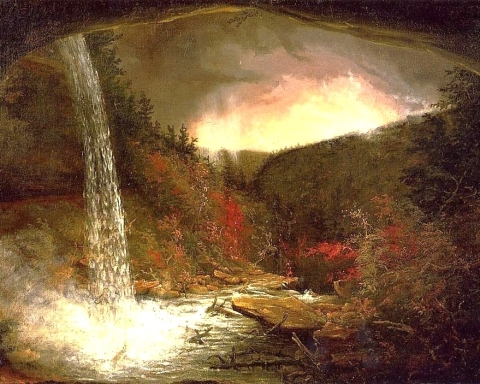
We are betting that you have been to Kaaterskill Clove. If so, then you will recognize it on the painting that Thomas Cole did there in 1827. See our illustration. Cole is widely remembered as the founder of the Hudson River School. Suppose a geologist from some other continent came along and looked over this painting. What would they see? What would they conclude about this landscape?
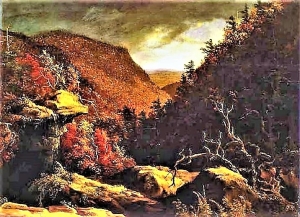
The Clove – Thomas Cole, 1827. Courtesy of Wikimedia Commons.
We suspect that the first thing that they would notice is the steepness of this landscape. There is a canyon here and its slopes are very, very precipitous. A geologist would conclude that the stream that cut this canyon was a very active one. Geologists used to call this sort of thing a “youthful” stream. The hypothesis was that this landscape had most likely been recently uplifted, perhaps by powerful tectonic events. The stream had responded by aggressively cutting into the landscape. Rapid downcutting had produced those steep walls. Hence, our hypothetical geologist would be imagining a tectonically active landscape – at least at first.
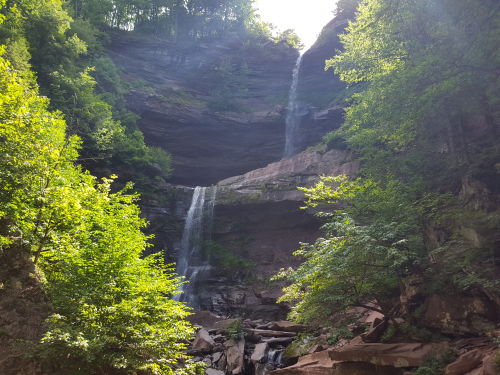
Our geologist would look at the bedrock in the foreground. He, or she, would conclude that it was pretty resistant stuff, probably a sandstone. They would go on to conclude that this sandstone made up the capstone of a waterfall. You can’t see the waterfall in this picture but the steep slopes, beyond, indicate the falls that do exist there.
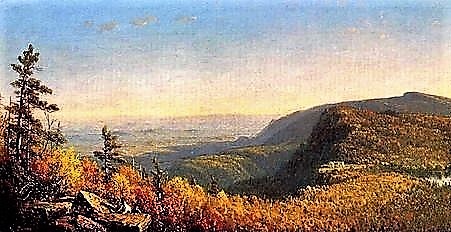
But then, our geologist would look into the distance and see what we know is the broad floodplain of the Hudson Valley. That would be a problem. Such floodplains take a lot of time to form. That is why they were, some time ago, called “mature streams.” They were emblems of very old landscapes.
So now our geologist would have a true dilemma. How could an old age landscape be associated with a youthful one. Well, here is where the two of us have to come in and answer some tough questions. We are locals and we know our way around here. Our mature Hudson valley floor is indeed an old landscape. The Hudson valley is tens of millions of years old and so it has had time enough to have earned its maturity. So how did its youthful landscape develop? How did the steep slopes of the Hudson Valley form so that Kaaterskill Creek could plummet down it’s slopes? That’s something that our foreign geologists could not figure out.
But we do know this secret and it takes us back to the Ice Age. Back then, our mature Hudson Valley was filled with ice. An enormous glacier was advancing to the south. It ground up against the wall of the Catskill Front and steepened it. That helped make that youthful landscape. If you have been to the Catskill Front, then you know about this.
Take another look at the Cole painting. Fill the Hudson Valley with ice; that ice has stopped advancing; it is now a melting glacier. Now fill that nearby canyon with raging, foaming, pounding, thundering, meltwater torrents. We are guessing that Cole would have enjoyed painting that scene.
==================================================================
Contact the authors at randjtitus@prodigy.net. Join their facebook page “The Catskill Geologist.” Read their blogs at “thecatskillgeologist.”