"I will never kick a rock"

Monthly archive

May 2026

the Vastness of Time – Pt. 1

in Uncategorized by


The vastness of time – Part 1: The Catskill Limestones

The Catskill Geologists; The Mountain Eagle; Feb. 12, 2020

Robert and Johanna Titus


To be a geologist is to live on a tiny island in a vast sea of time. Earth history extends backwards a full 4 1/2 billion years. The future of our planet will be equally long. Our three score and ten is so small compared to all that. But a fair question is: how do we know that? The best answers are provided by geochemists who can make these determinations from the study of various chemical isotopes found within some rocks. That’s hard science but it does not make for a very good read. We would like to take a different approach to this question and, at the same time, a far more spiritual one.

Have you ever been to Thacher Park? It lies at the edge of the Helderberg Escarpment and overlooks a distant Albany. It’s a picturesque location, a massive cliff rising above the Hudson Valley. The Helderberg Escarpment is composed of the Devonian aged Helderberg Limestone, rocks almost 420 million years old. It’s a very important unit of rock. It’s hundreds of feet thick and extends westward far past Syracuse. It makes up a great ledge that runs down the Hudson Valley as well. In fact, it’s our recollection that this limestone is spread out across most of eastern North America. That’s a big unit of rock. What’s the story behind this story?
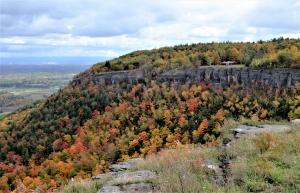
Thacher Park

Well limestones, in fact, conjure up quite a tale. Each of them formed in a shallow tropical sea which had been floored with limey sediments. But what exactly is limestone? Take a look at our second photo; it shows a view of a microscopically thin sheet of a typical fossiliferous limestone. The dark particles are fossils, fragments of ancient shellfish skeletons. Those had been mostly shells that came to be broken up and rounded in active seafloor currents. They are composed of the mineral calcite, CaCO3, the very stuff of limestone. The clear white material in between those fossils is pure crystalline calcite cement.
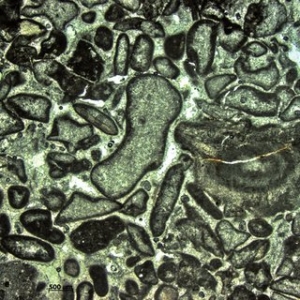
This is a typical limestone lithology and it speaks of great lengths of time. How long did it take for all those generations of shellfish to live and die? How long did it take for chemistry to produce all that cement? The answers to both questions speak of enormous lengths of time. It gets worse. As we have seen, that Helderberg Sea was huge, being spread out across so much of north America. How long did that take to form? Again, the answer to the question forces us to contemplate what seems to be endless eons.

The spiritual part comes along when we let ourselves waft back through time to visit Thacher Park during that early Devonian time period. Suddenly we find ourselves drifting across the shallow Helderberg Sea. Below us we see reef building animals called stromatoporoids, animals now long extinct. We rise up a bit into the air. We are the mind’s eyes and we can do that. Below us we now see the dark shadows of those reefs. All around them are the pink limy sands that will someday be limestones. They are dotted with living shellfish. Here and there we see green patches of algae, plant like creatures that flourished in those sunlit waters. We rise up still higher and higher. Now we are thousands of feet up; soon it will be miles, many of them. The full expanse of the Catskill Sea is opening up before us. It is an aqua colored sea spread out across the vastness of a now global geography. It looks like something that has always been there; it looks like something that will always be there. Looks are deceiving.

  Contact the authors at randjtitus@prodigy.net. Join their facebook page “The Catskill Geologist.” Read their blogs at thecatskillgeologist.com.
A Mystery at Pratts Rock

in Uncategorized by

A real geological mystery, and at Pratt’s Rock

The Catskill Geologists; The Mountain Eagle 5-31-19

Robert and Johanna Titus


We were invited to speak at the Pratt Museum recently. Our topic was the glacial geology of the Schoharie Creek Valley. After that, a group of us went to Pratt Rock and climbed up the trail there. We took a look at Colonel Pratt’s carvings and continued on to see some nice ice age features. But, along the way, we ran across one of those mysteries we have long struggled with.

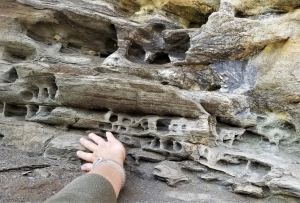
We were first alerted to this particular mystery by Paul Misko, a veteran Catskills hiker. Paul told us of some “very strange structures he had found in Phoenicia. Paul has a real eye for unusual geology, so we paid attention to his “very strange” claim. We saw his Phoenician structures and now we have found more of them at Pratt’s Rock. Take a look at our photo and then climb up the steep incline at Pratts Rock and keep an eye out. Towards the top you will find sizable ledges of sandstone. This is rather commonplace stuff: very typical Catskills bluestone ledges. These ledges are, in essence, the cross sections of some very old streams. It’s, like all rocks in the Catskills, Devonian in age, something a bit less than 400 million years old.

None of this surprised us in the least but that’s where we encountered that mystery. Take another look at our photo and see what you think. See the cluster of closely spaced and very strange cavities just above the hand. Their shapes vary considerably, but they all show a sort of boxy nature, and they seem to form an interlocking network. We would like to use the term honeycomb here, but honeycombs show a consistent hexagonal shape; we don’t see that with these. The rock remaining in between these cavities is narrow. The cavities do not penetrate too far into the rock, just a few inches. And there is no reason to think that there is another horizon of these cavities under the ones that are visible. Thus, they appear to be surficial features. Many of these cavities are spaced so close together that they comprise a bigger compound cavity. Whatever it was that formed them was focused.

All in all, this is one of the most puzzling phenomena that we have seen in the Catskills. There is no trouble putting a name on what is here; these structures are called “tafoni.” Each individual cavity is a tafone; lots of them are tafoni. And the terminology keeps getting better; when tafoni occur on cliff faces, as here, then it is called lateral or sidewall tafoni. But putting a name on something is not the same as understanding it.

What are these features? They seem to be chemical weathering phenomena. Somehow, they appeared on the rock surface and grew slowly into their observed shapes, but exactly how? And, also, how is it that they grow in size until they abut each other but do not grow into each other? How do they grow in size without intersecting? Those are very puzzling questions and just naming these things does not provide answers.

Tafoni have been weakly associated with poorly defined stratification on the sides of cliffs and that is the case here: sort of. But that still leaves a lot unsaid. Why does this “association” occur? What are the specifics? Salt is commonly cited as an agent in tafoni development. They are sometimes found on coastal outcroppings, splashed by ocean waves. But there is certainly no source of salt here on a sandstone cliff in Prattsville, and certainly no waves. And, why do only a few Catskill Cliffs display these? That begs the question: what exactly is different about his cliff? Why don’t all cliffs have tafoni? Why isn’t it that none of them do? There must be something here, right in front of our eyes, which we have missed. This is the sort of thing that makes science so much fun.

Do you have any ideas or questions? Have you seen tafoni somewhere? Contact the authors at randjtitus@prodigy.net. Join their Facebook page “The Catskill Geologist.” Read their blogs at “thecatskillgeologist.com.”

Go to Top