"I will never kick a rock"

Monthly archive

April 2025

The Origin of Flint; Apr. 28, 2025

in Uncategorized by


Our Reader’s Rocks: the Origins of flint.

The Catskill Geologists; the Mountain Eagle, Oct 17, 2017

Robert and Johanna Titus


Dear Bob and Johanna: My husband and I were out exploring north of Rte. 145 (near intersection of County Rtes. 443 and 156) in Berne when we found an interesting outcrop. One of the rock strata had peculiar black masses within it. I am sending a photo. Can you tell me what this is? Debra Teator, Freehold.
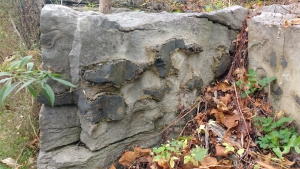
Thank you Mrs. Teator. You did the right thing sending us a photo. They can be very helpful. We can’t always identify geologic features from a photo, but this time we can. The gray rock surrounding those black masses belongs to something called the Helderberg Limestone. We expect to be writing a lot about the Helderberg as it is a very important local unit of rock. Its most important aspect is that it takes us back about 400 million years to a time when almost all of our region lay beneath the waters of a shallow tropical sea. If we could transport you to that Helderberg Sea, you would look around and swear that you were in the Bahamas.

The Helderberg Limestone is very well exposed at John Boyd Thacher Park, and we did not know of your outcrop in Berne. The Helderberg is composed of several subunits called formations, and this one is the Kalkberg Formation. Its sediments were deposited well offshore, in waters that were certainly not deep but might be best described as subtidal. If you were at the bottom of the Kalkberg Sea during the daytime, then you could look up and probably see a lot of sunlight.

Now, what is chert and how did it form? Chert is described as being microcrystalline quartz. That makes one of nature’s most common types of minerals: quartz. But, unlike normal quartz, its crystals are extremely small. That’s the easy part; what is harder is figuring out exactly how it formed. Late at night, in geology bars, this has always been the subject of debate. We will tell you our best understanding.

The first thing that happened is that the sediment that makes limestone was deposited. This stuff consisted of very small grains of calcium carbonate (CaCO3). Most of those grains had previously been parts of the shells of shellfish. Clams, snails and other shell-bearing organisms had died and their skeletons had broken up into grains of sand, silt and clay.

After this sediment had been deposited but before it hardened into rock, it was affected by chemical processes. If we understand it properly, water rich in dissolved silica (SiO2), was being squeezed out of the soft, wet sediments. When the dissolved silica reached layers of sediment that had a low pH, which is also known as a high acidity, then the microcrystalline quartz crystalized as chert. The chert formed into globs which are commonly called chert nodules. If the nodules grew large enough and were abundant, then they would grow into each other and form strata of chert. That is what is seen in the photo.

So, today’s journey into the past has taken us into 400 million year old sediments and allowed us to watch the formation of chert. This material is better known to most people as flint. That’s the stuff that Stone Age cultures learned to fashion into stone tools, such as arrowheads. It also functioned in flintlock rifles.

Contact the authors at randjtitus@prodigy.net. Join their facebook page at “The Catskill Geologist.” Read their blogs at “thecatskillgeologist.com.”

   Have you found some geology we might want to write about? Send us a photo.
The Origin of Flint = Apr. 28. 2025

in Uncategorized by

Our reader’s rocks: the origins of flint.

The Catskill Geologists, The Mountain Eagle, Oct 27, 2017

Robert and Johanna Titus


Dear Bob and Johanna: My husband and I were out exploring north of Rte. 145 (near intersection of County Rtes. 443 and 156) in Berne when we found an interesting outcrop. One of the rock strata had peculiar black masses within it. I am sending a photo. Can you tell me what this is? Debra Teator, Freehold.

Thank you Mrs. Teator. You did the right thing sending us a photo. They can be very helpful. We can’t always identify geologic features from a photo, but this time we can. The gray rock surrounding those black masses belongs to something called the Helderberg Limestone. We expect to be writing a lot about the Helderberg as it is a very important local unit of rock. Its most important aspect is that it takes us back about 400 million years to a time when almost all of our region lay beneath the waters of a shallow tropical sea. If we could transport you to that Helderberg Sea, you would look around and swear that you were in the Bahamas.

The Helderberg Limestone is very well exposed at John Boyd Thacher Park, and we did not know of your outcrop in Berne. The Helderberg is composed of several subunits called formations, and this one is the Kalkberg Formation. Its sediments were deposited well offshore, in waters that were certainly not deep but might be best described as subtidal. If you were at the bottom of the Kalkberg Sea during the daytime, then you could look up and probably see a lot of sunlight.

Now, what is chert and how did it form? Chert is described as being microcrystalline quartz. That makes one of nature’s most common types of minerals: quartz. But, unlike normal quartz, its crystals are extremely small. That’s the easy part; what is harder is figuring out exactly how it formed. Late at night, in geology bars, this has always been the subject of debate. We will tell you our best understanding.

The first thing that happened is that the sediment that makes limestone was deposited. This stuff consisted of very small grains of calcium carbonate (CaCO3). Most of those grains had previously been parts of the shells of shellfish. Clams, snails and other shell-bearing organisms had died and their skeletons had broken up into grains of sand, silt and clay.

After this sediment had been deposited but before it hardened into rock, it was affected by chemical processes. If we understand it properly, water rich in dissolved silica (SiO2), was being squeezed out of the soft, wet sediments. When the dissolved silica reached layers of sediment that had a low pH, which is also known as a high acidity, then the microcrystalline quartz crystalized as chert. The chert formed into globs which are commonly called chert nodules. If the nodules grew large enough and were abundant, then they would grow into each other and form strata of chert. That is what is seen in the photo.

So, today’s journey into the past has taken us into 400 million year old sediments and allowed us to watch the formation of chert. This material is better known to most people as flint. That’s the stuff that Stone Age cultures learned to fashion into stone tools, such as arrowheads. It also functioned in flintlock rifles.

Contact the authors at randjtitus@prodigy.net. Join their facebook page at “The Catskill Geologist.”

   Have you found some geology we might want to write about? Send us a photo.
in Uncategorized by

An ancient river channel

Robert and Johanna Titus

The Mountain Eagle; The Catskill Geologists; Oct. 20, 2017


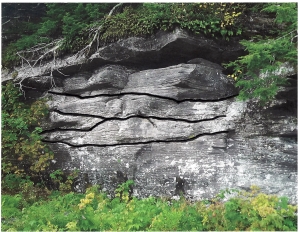
Every so often, in our columns, we refer to a sizable ledge of sandstone as being the cross section of a Devonian age stream channel. The Devonian part is easy; all of the bedrock in the Catskills is Devonian in age (419 to 359 million years ago). But what about the stream channel part? How, exactly, is it that we know that?  That’s a fair question and we think we should take a crack at answering it. Let’s do that this week. Recently we were over at North Lake, on the Catskill Front. Our primary interests on that day was the ice age history of the land that lies between North and South Lakes. But, we came across a massive ledge of light colored sandstone and it caught our eyes. We took a good look and a good photo. We had seen some interesting structures within that sandstone.

Well, what we had seen were a number of erosion surfaces. We printed up our picture and then inked in those erosions. Take a look at our photo. This had been a sizable river. Its sandstones must be twelve feet or so in thickness. You need a river pretty much that deep just to accumulate all that sand. This river lay at the bottom of the steep slopes of a mountain range. These were called the Acadian Mountains and they towered above what is now western New England. Streams, that descended their slopes, would have flowed out onto what we call the Catskill Delta. They carried a lot of sediment, most of it sand. These sands came to be deposited where North Lake is today. These were likely large and powerful streams. They would have been occasionally subject to great flooding events. It is only logical to think that, from time to time, it rained a lot up in the Acadians. Those storms generated powerful flows of water, carrying large amounts of sand. When the streams flowed far enough out onto the delta then their flows slowed down and the sand came to be deposited.

If all that is true, then we should see the evidence in outcroppings, such as the one in our photo. We think that the evidence is there – in the inked lines. Each flood event must have reached a peak, when the flows were at their maximum levels. Those flows, it only seems logical, would have eroded into the sediments of the stream channel. When we inked in those erosional surfaces, we thought we had identified such events. The bottoms of these surfaces are concave and they, each one of them, look like features that had been eroded.

There are at least four of these erosional surfaces in our outcrop, or about one every three feet. We think that each of these surfaces records the peak of a major flood event. During that peak, the flood currents would have picked up large amounts of sand and swept it away. As the flood passed its peak, currents slowed down and most of that sand would have come to rest as a new deposit. Most of the sand in between these erosion surfaces seems to have been deposited at the end of its flood or during quiet times that followed.

How often did these floods occur? We can come up with a very approximate estimate. There are about 4,000 feet of sedimentary rock found in this Devonian sequence and it took about 11 million years to deposit them. That averages out to about 2,700 years per foot of sedimentary rock. If there were three feet per flood and if all the above is true, that means that these floods occurred every 75,000 years or so! That’s a lot of time. That’s also a guess.

But, most importantly, all this is consistent with the notion that such sandstone ledges were once stream channels.

Contact the authors at randjtitus@prodigy.net. Join their facebook page “The Catskill Geologist.” Read their blogs at “thecatskillgeologist.com”


Our 2025 Talk For the Geological Society of America 4-7-25

in Uncategorized by

Integrating Geology into the Local Community

Robert and Johanna Titus

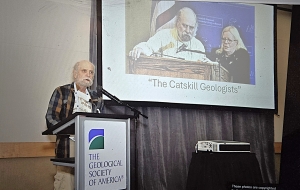
  We are ‘the Catskill Geologists.” After successful careers as academic scientists, we have become popular science writers. We have blended geology into the regional culture of the Catskills and upper Hudson Valley. This started in 1991 when Robert began writing for Kaatskill Life magazine. Later Johanna joined him, and we did four columns per year for 30 years. We published four books as well. These all described the area’s bedrock and Ice Age history, written at a level both readable and, more importantly, interesting to the everyday resident. This led to more than a thousand columns in several of the area’s newspapers, especially The Woodstock Times and today, The Mountain Eagle.


With a growing and widespread popular interest in our region’s geology, came a spillover to work with local civic groups who were looking for lecturers and nature walk leaders. These include the Woodstock and Columbia Land Conservancies, the Mountain Top and Greene County Historical Societies, The Catskill Arboretum and the Roosevelt Presidential Library. Self-guided geology trails were designed for several of those groups.

With sufficient public awareness, a facebook page and a blog site became helpful providing direct communication with readers. There were frequent guest appearances on local radio and television stations. We even hosted our own radio talk show on the local PBS channel WIOX. That focused on the geological history of the Schoharie Creek Valley. Recently we have related the Hudson River School of Art to the local Ice Age history. We argue that the glaciers sculpted the landscapes that inspired the painting.

The theme that we are advocating is that every community has its own local newspapers and magazines. public broadcasting stations, libraries, museums, preserves and other civic groups. All may be open to making a place for well explained geoscience. Our science can be an integral part of our communities and we geologists can enjoy rewarding lives of community engagement.

Through Time at Kaaterskill Clove 4-2-25

in Uncategorized by

A Journey through time in Kaaterskill Clove

The Catskill Geologists – The Mountain Eagle; 11-3-17

Robert and Johanna Titus


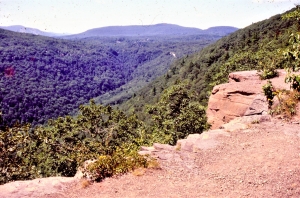
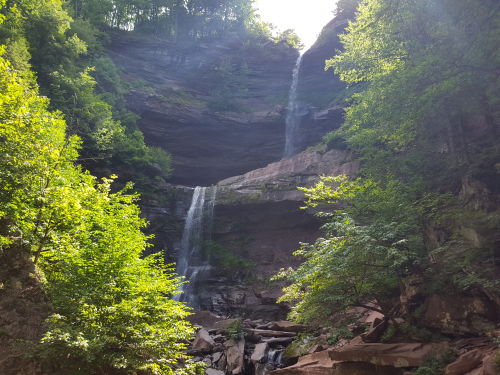
Have you ever hiked the north rim trail at Kaaterskill Clove? It’s one of those many great experiences that anyone living in the Catskills should have done – perhaps, like us, many times. Better still, it’s something you should take visitors to see. When we go there, we stop at Inspiration Point and look down about a thousand feet or so, and gaze into the distant past. Way down there, about 15,000 years ago, was a raging, foaming, pounding, thundering, whitewater torrent. Those were the waters of the melting glaciers of those late ice age times. That flow did most of the work of carving Kaaterskill Clove. That’s what makes this truly a geological wonder.

But there is still an older time, represented down there. Down in the very depths of the canyon, there are stratified sandstones and shales. The canyon is about a thousand feet deep here, so there must be an equal amount of stratified rock. Those rocks are middle and late Devonian age, which makes them about 385 to 375 million years old – that’s in very round numbers. It’s natural for geologists to ponder such vast numbers. We are pros; we are professional scientists, and we are not supposed to wax poetic about such things, but – we can’t help it.

The two of us began to wonder just how many years had passed by from when the oldest strata, at the bottom of the Clove were deposited, to when those at the top came to be. We got out some publications from the New York State Museum and began to make some “guesstimates.” We are only going to make some gross approximations today; so don’t hold us to any of our numbers. We just want to give you a notion of when all the stratigraphy at Kaaterskill Clove came into being, and how long it took to be deposited. If somebody thinks they can come up with better numbers, we welcome them.

We think the strata at the bottom of the canyon belong to a unit of rock called the Plattekill Formation. The Plattekill is a unit of gray and brown sandstone. The New York State Museum places the middle Plattekill at about 385 million years in age. We think the top of Kaaterskill Clove corresponds with the top of the Oneonta Formation, a largely red sandstone, and that makes it about 381 million years in age. The math is pretty easy; we get about 4 million years of time represented from the bottom to the top of the clove’s stratigraphy. Remember those 1,000 feet that the canyon encompasses? Well, we divide through and we get about 4,000 years per foot of stratified rock.

Now, none of this is great science, and none of it is great math. A foot of river sandstone might have been deposited in a few hours. A foot of red shale may have taken many, many thousands of years to form. There must have been sediments from vast expanses of time that were eroded away and lost forever. Other great lengths of time just never saw any deposition at all. But, we think we have come up with some reasonable approximations and that is all we are aiming at.

Again, stand atop Inspiration Point and look down those thousand feet. See 4,000 years of time for every foot below you.

Contact the authors at randjtitus@prodigy.net. Join their facebook page “The


Go to Top