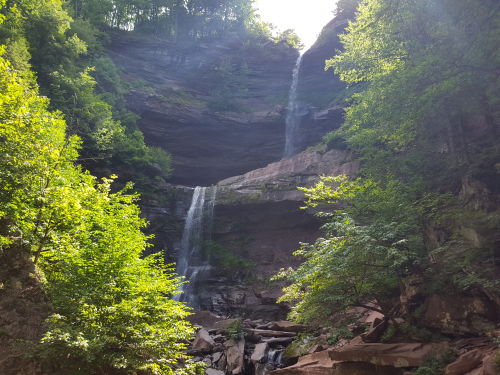
The weathering of another very old rock
The Catskill Geologists
Robert and Johanna Titus
This week let’s look at another picture done by our friend, photographer Art Murphy. This is a gem! We like Art’s photographs so much that, a few years ago, when we had the chance, we did an exhibit with him at the Catskill Center in Arkville. We displayed a number of our most interesting Catskills rock specimens, and, across the room, Art put up a number of his photos. Each exhibit, rock or photo, displayed something from the Devonian history of our Catskills. The two exhibits complemented each other, and we think the show was a success.
But that was then, let’s get down to this week’s business. We have been talking about chemical rock weathering in recent columns. Those are processes whereby chemical activities work to destroy a rock, to break it down, and in a sense decompose it. They eventually turn it into soil. Weathering is one of those fundamental processes in nature. It takes rock, turns it into earth and sets it up to be eroded. As they erode, their landscapes comes to be destroyed. Given enough time all the rocks of a mountain range will weather and erode. Even great mountains, no matter how tall they might have once been, will simply erode away.
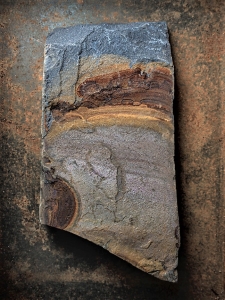
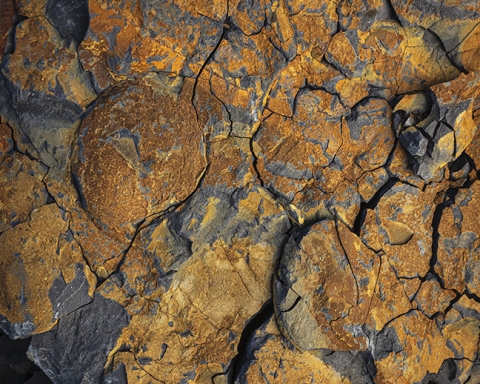
Last week we saw oxygen “rusting” the iron bearing minerals in rocks. This week we will see something similar. Take a look at Art’s photo. See the prominent yellow and brown stripes on the surface. The blue gray is the natural rock beneath those hues. It’s a handsome rock and that is why Art chose it to be photographed. It looks as if an artist, armed with a brush, had painted that rock. It’s not abstract expressionism; it’s a form of art that nature does herself. Mineralogy is not our field, so we are going to have to do a little guessing here, but we think we know what was going on when all this formed. We believe that the yellow is the same stuff we saw last time; we think it’s the mineral limonite. It formed when the oxygen in water attacked the iron that was already in the rock. So then, what is the brown? We are guessing once again; we think that it is a related iron oxide, a brown one, and that is probably a mineral called goethite. It’s just a little differently oxidized than limonite. So, how exactly might these minerals have formed? We think that there had been a crack in the rock and that water soaked into it. The oxygen in that water attacked the iron in the rock and turned it into limonite or goethite, depending on how much oxygen was available. There was just a little extra oxygen near the edge of that water. There the limonite was produced.
After a period of time, the water evaporated, and those minerals crystalized, left behind as the film we see on the surface of the rock. This was an initial step in the weathering of the rock. We are guessing all of this, but we like the story; it’s probably not all that far off. What’s most important is that we alert your eyes to watch for this sort of thing when you are out looking at rocks. We have more to write about weathering. Next week we will take it one step further along.
Contact the authors at randjtitus@hartwick.edu. Join their facebook page “The Catskill Geologist.” Read their blogs at “thecatskillgeologist.com.”