"I will never kick a rock"

Monthly archive

July 2025

A Glacier at Pratt Rock. 7-29-25

in Uncategorized by

A glacier at Pratt Rock

The Catskill Geologists; The Mountain Eagle June 14, 2019

Robert and Johanna Titus

We were happy to read in the Mountain Eagle of plans for the upcoming restoration of Pratt’s Rock. It’s quite an unusual location; it’s been there a long time and does need an upgrade. We look forward to seeing what will happen, and we hope, when things are done, there will be some appreciation for the geological heritage of this fascinating rock.

Had all gone to plan then Zadock Pratt would have had quite the Mausoleum up there, but that did not happen. Nevertheless, Pratt does have an impressive monument. Probably most all of you have visited it. Many of you have climbed up and seen closeup the carvings that are there. There is still a chamber where Pratt planned to be buried. Then there is the poignant image of Pratt’s son George who died at the Civil War’s Second Battle of Bull Run.

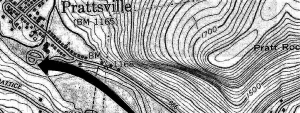
None of this would have or could have been if there had not been such a steep slope there to begin within. Take a look at our first illustration; it shows a topographic map of Pratt’s Rock. Can you “read” contour lines? Then you will recognize the steep Pratt Rock slope from the closely spaced contours. It’s nearly a cliff and it faces the valley of Schoharie Creek which flows through Prattsville. Ledges of Catskill sandstone tower above the valley. A ledge is just a ledge, isn’t it? Well, not where we come from; we are geologists and we know there is a deeper story here
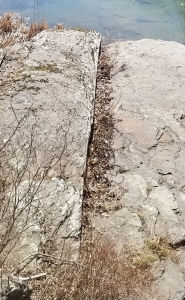
We hike up to the carvings and then continue onwards to a ledge that offers a fine view of the valley. See our second illustration, a photo of that ledge. Notice the smooth surface and the sharp drop-off of the ledge; there is a cliff there. Less obvious, but quite important, are the scratches on that surface. There is a lot of ice age history here. We look and we see what is called the Schoharie Creek glacier passing by. It has flowed south, swelled up to fill the valley and passed across this sandstone. The ice carried a lot of sand with it, mostly concentrated at its dirty bottom. That sand acted as sandpaper and produced the flat surface. There was more, the glacier carried cobbles and boulders along with the sand. They were dragged across this surface and that produced those scratches which geologists call striations. Knowing this, now you can see that they parallel the glacier’s movement down the valley.
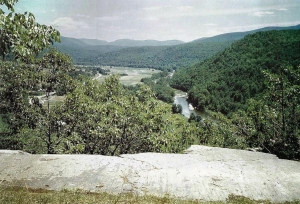
What about that cliff? That’s all part of the same story. Glaciers can be sticky. A glacier, when it passes across a mass of rock such as this, forms a tight bond with it. The glacier continues its journey south, it exerts a tug upon that rock. It is quite possible that the tug will break loose a mass of rock and yank it loose. That’s what happened here. There is nothing unusual about this; we geologists see such things frequently. It has a name; we call it glacial plucking. We stand at the top of this cliff, look down the valley and know that somewhere down there is all that missing rock, buried in the floodplain.

Well, the story we have just related, goes a long way to explain how it was that Pratt’s Rock came to be. It started out as an ice age feature. But there is a lot more to this story. Let’s continue next week.

Contact the authors at randjtitus@prodigy.net
AQ Fossil Feather? July 15, 2025

in Uncategorized by

Fossil feathers?

The Catskill Geologists; The Mountain Eagle, Apr. 24, 2020

Robert and Johanna Titus


   Last week we visited several locations in East Durham where we saw geological features called joints. These are fractures that formed within the rocks hundreds of millions of years ago. Each joint fracture is the product of an instantaneous snapping within the rock. Unlike most fractures these are absolutely straight, especially when viewed from above. Take a look at our first photo.

But what do we see if we can get a chance to look at them sideways? That’s commonly the case and when we do get this second view, we typically see a smooth flat vertical surface. But some views are more revealing; take a look at our second photo. This one shows a vertical view of a joint, but this one is only nearly, not perfectly flat. This surface is covered by what geologists call plumose structures. The name comes from the superficial similarity of these structures with bird feathers. Once again, as is so often the case, we have some explaining to do. Plumose structures date back to the very moment when that joint formed, to the actual instant when it snapped.

The rock in our second photo is Devonian in age; it is about 385 million years old. It’s sandstone and probably its sand was deposited in the channel of a Devonian river. Those sands hardened into rock and subsequently it became involved in one of the greatest mountain building events in Earth history. That was the Acadian Orogeny, an event that produced an early version of the Appalachians, called the Acadian Mountains. The rocks in our photo were, for a long time, compressed by that collision. During this event, these rocks lay deep within the bowels of those ancient mountains. There they were subjected to truly intense pressures. Imagine all this for just a moment. Typically, rocks have a good deal of “give” to them and they can absorb the stress pretty well. It wasn’t until much later that they encountered trouble.

The mountain building event we are talking about involved a great landmass that you might call Europe, colliding with North America. That is where the compression came from. It only got worse later on when Africa collided with North America. Mountain building collisions, no matter how large, only last so long. Eventually this history of collisions ended, and, in fact, a breakup of the land masses occurred. Both Europe and Africa drifted back to the east toward where they are today. That released all the pressure that had been compressing our rocks.

In this new relaxed state of affairs, these rocks began to expand back to their original state. They became brittle, and that’s when the fracturing occurred. A plumose structure is a special type of crack. Essentially, the fracturing began at the base of the “feather” (left on our photo) and expanded away from that point. As the fissuring “rippled” through the rock it created the plumose pattern.

This was an exciting moment; things happened fast. Its’s our understanding that the fracturing occurred at something that approached the speed of sound! And it must have made a lot of noise too, a very loud pop or snap. All this amounts to another of those most remarkable features so often found in rocks. This was not just a little bit of deformation; this must have been a real earth thumping event. For all practical purposes this is a petrified earthquake. Think about that for a moment. You can actually preserve the evidence of an ancient earthquake in the rocks!

And photograph it.

Contact the authors at randjtitus@prodigy.net. Join their facebook page “The Catskill Geologist.” Read their blogs at “thecatskillgeologist.com.”

Go to Top