"I will never kick a rock"

Monthly archive

March 2025

Grand Gorge – March 18, 2025

in Uncategorized by

Our reader’s rocks – Ice in Grand Gorge Gap?

The Catskill Geologists; Robert and Johanna Titus

The Mountain Eagle; Sept.15, 2017


We always give our email address at the bottom of each of our articles. And we can always be approached on our facebook page, so we hear from a lot of our readers. Often they have questions and we are usually able to help tem with answers. Every once in a while, we thought we would answer one of these queries in the form of a column so here goes the first.

Recently we heard from a Gerry Hubbard. He sent us a photo of Grand Gorge Gap and wanted to know what the rounded hump on the right is. Take a look at our photo and you can see that hump. We had been wondering the same thing for years and so Gerry’s request got us to do something about the problem.
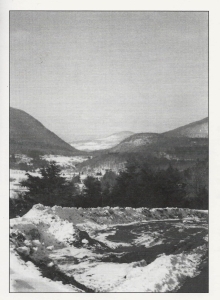
The first step is to get our topographic maps out and look at them. We found that the Roxbury 7 1/2 minute quadrangle map displayed the Gap. We found that the hump has a name; it is Jump Hill. Then we went back to our photo. The “hump” is actually something that lies in between two valleys. The contour lines on our map indicated a steep but steady slope for each of the two valleys. Each one of those is what geologists call a U-shaped valley. Every trained geologist on the planet Earth quickly recognizes the ice age history of such a valley. They record the passage of glaciers. As ice squeezed through a valley it ground away and eroded the bedrock. The shape that offers the least resistance is the U. Not surprisingly, over a period of time, glaciers will carve those U’s into the bedrock landscape. It gives each of them a path of least resistance. That forms a remarkably picturesque image and that helps make glaciated landscapes so attractive. We geologist are most fond of these U-shaped valleys.

Well, we studied the map and our photo and started speculating about what had happened here, way back, near the end of the Ice Age. Speculation is a word that scientists like to avoid; it sounds so – well speculative. So we use the word hypothesize instead. It sounds better. We hypothesized the following story: We hypothesize that the larger U-shape, on the left, is the older of the two. We think that a sizable glacier entered Grand Gorge Gap and began eroding the large U-shaped valley. Somewhere along the line, the ice was diverted and a second stream of it passed through what is the smaller, and we think younger, U-shaped on the right. All this erosion left Jump Hill in between.

We hope that Gerry likes our hypothesis. It conjures up quite an image. We travel north on Rte. 30 to where we can park and see this view. In our mind’s eyes we can imagine the advance of these glaciers; we can watch them carve the shapes of Grand Gorge Gap. That view gives us a whole new perspective on this site.

We hope you enjoyed our hypothesis. Perhaps you have a location that we could write about. Let us know.

Contact the authors at randjtitus@prodigy.net. Visit their facebook page at “The Catskill Geologist.”
Why Gilboa? 3-10-25

in Uncategorized by


Why Gilboa? By Robert and Johanna Titus

The Catskill Geologists in The Mountain Eagle

Sept. 15, 2017


   Gilboa was, a century ago, a sizable town in the center of the Catskills. We have been told it was once as big as Cobleskill. But fate struck; New York City reached out and took the land the town was built on, and used that for a reservoir. A dam was constructed just a little west of the old town. The village was razed and, when the dam was filled with water, it disappeared altogether. What little is left, is at the bottom of the reservoir

It was a sad fate, and one which is still deeply resented. But, why did it happen? What was it about Gilboa that led to its demise? We decided to see if we could answer that question. We could not go back through time and travel to the offices where New York City engineers were making their decisions. We could not talk to them, or read their minds. And, much of the geological evidence is now hidden from sight, at the bottom of the reservoir. But, there are other sources of evidence. Perhaps we could read those minds!

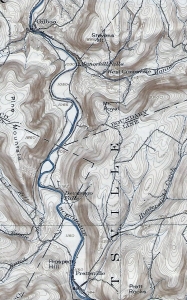
We have one of the maps that those long ago engineers must have used. It’s what’s called a 15 minute quadrangle map of the Gilboa area, published by the New York State Department of Public Works. Ours is the 1903 edition, so it is the very one that those engineers were likely eye-balling as they searched for likely locations for New York City reservoirs. We could look at this map and think as they must have.

We have selected that part of the map that shows the Schoharie Creek Valley where it stretches from Prattsville, north to the onetime site of Gilboa. That’s where the reservoir went. Take a good careful look. Do you see all those narrow lines? Those are contour lines. They define different elevations. The bottom of the valley was at about 1,050 feet in elevation. If you look carefully, you can see the 1,050 foot contour line, just to the right (east) of the creek.
The bottom of the creek was valley floor flatland. It must have been good farming. Notice the absence of contour lines down there. Flat land has very few, or no contours. But the valley walls are different; there contour lines are closely spaced. A person who, back then, climbed up those slopes would have frequently crossed contours.

Experienced geologists can “read” such maps and learn so much from them. Well, we studied the map and began to see the Gilboa area as it had been, before the reservoir and its dam. We saw that most of the valley floor, all the way south to Prattsville, had been wide and flat. We know that this had been the bottom of something called Glacial Lake Schoharie, and those flatlands must have been lake-bottom silts. Easy to plow, these acres must have been wonderful farmland.

But look where Gilboa was; there the contour lines crowd the valley floor. That’s where the Schoharie Valley had been surprisingly narrow. Those long ago engineers must have seen the potential. Gilboa was located right where the valley was narrow and easily dammed. Behind that planned dam, was a wide valley with a flat floor.

The Gilboa site was ideal for damming; the lands behind that dam would be perfect for a reservoir. Gilboa’s fate was sealed; the town was doomed!

Contact the authors at randjtitus@prodigy.net. Join their facebook page “The Catskill Geologist.”

Glacial Lake Windham – Mar 3, 2025

in Uncategorized by

A visit to Glacial Lake Windham

The Catskill Geologists

Robert and Johanna Titus

The Mountain Eagle – Sept. 8, 2017


Last week we visited Windham, actually the Windham Path, just east of town. We wanted to show you something about the ice age origins of the town. Most of the Windham Path lies upon the floor of what’s called a glacial lake. That lake had come into being when a glacier deposited heaps of sediment in something called a moraine. The moraine can be seen just east of the Path. Most of the land from east Windham to here is rolling elevated moraine landscape. That’s the land lying just east of Mitchell Hollow Road.

Let’s learn some more this week. We would like you to drive west from Windham on Rte. 23. You may have done this before, perhaps many times. But, as always, we want you to be paying more attention to the landscape that you are passing. We, especially, want you to take heed of the flat landscapes down at the bottom of the valley. It would be easy to dismiss this as a floodplain, after all valley floors are supposed to display floodplains. But, you would be wrong; this flat landscape is the floor of an ice age lake. Lake deposits are almost always spread out as flat sheets. That’s what we see here.

These lake bottom landscapes continue at least as far west as Ashland. They speak to us of a glacial lake. It was a big one, extending at least five miles from the Windham moraine to a bit west of Ashland. Rte. 23 lies on a platform that runs parallel to the old lake. That platform also has an ice age origin. It is composed of sediments that were dropped down the northern valley wall and deposited as a lakeshore deposit called a glacial terrace. That terrace was irresistible to highway engineers when they were making Rte. 23. It lifted the highway up onto a well-drained surface.

The top of the terraces was deposited at just about the old lake level. Our topographic map tells us that that level was at about 1,500 feet in elevation. The map also tells us that the lake bottom lay at about 1,450 feet. We can thus calculate that the lake was about 50 feet deep. It got a good bit deeper toward Ashland. Turn south (left) at Jewett Heights Road and, when you get down to the river, stop and get out. You are now standing on the floor of a deep lake! Have you ever done that before?

You might do a little exploring. Look for a vantage point, somewhere above the 1,500 foot level. Now you can look down and, in your mind’s eye, you can survey Glacial Lake Windham as it once was. We picked a day, very late in the Ice Age. The climate had been warming up considerably and the ice had melted off most of the lake’s surface. There was, however, still a narrow shelf of gray ice all around the lake’s shore.

We were hoping to see some animals. Perhaps a mastodon or two might have been walking the shores of the lake. But, we were disappointed. It was not that late in the Ice Age, it was still too cold in Windham.

Contact the authors at randjtitus@prodigy.net. Join their facebook page “The Catskill Geologist.”

Go to Top