"I will never kick a rock"

Monthly archive

May 2022

Roeliff Jansen Kill – Part 5 – Elizaville

in Uncategorized by

Roeliff Jansen Kill, Part 5: Twin Lakes

Stories in Stone

Updated by Robert and Johanna Titus


The Roeliff Jansen Kill is certainly not one of the world’s great rivers; in fact, it is not much more than a run-of-the-mill creek. But this is the fifth article that we have written about the Roe Jan. We picked it up near its source and have been following it downstream, tracing its journey to the Hudson River. Each of our first four installments has revealed an entirely different facet of the kill. Each segment of the creek has brought to light a separate geological “personality.” That’s remarkable and we are only just past the halfway point!

Last time we had arrived at Elizaville. There we found that the Roe-Jan had emptied into what is known as Glacial Lake Albany. That was an expanse of cold water that spread across much of the Hudson Valley at the close of the Ice Age. We ended up standing along Hapeman Road, realizing that we were at the bottom of a 60-foot-deep ice water lake.

We can begin this episode where we left off. Gaze up those 60 feet and appreciate that you are on the floor of an old lake. At noon, on a late ice age day, you could have looked up here and seen the sunlight playing upon the passing waves. Occasionally cakes of ice, mini-icebergs, would drift by, swept along by the wind. To be a geologist is to be able to plant each of your two feet firmly in different moments of time and we can really do that here. Look off to the west; we see one of your feet on today’s flat landscape and then also see your other foot standing upon the dark still, muddy bottom of a lake. What of this, exactly, is imagination and what, exactly, is real?  And where are the boundaries of the imagined and the real? To be a geologist is to experience such things.

But we must continue. Drive back east on Hapeman Road and arrive at a good vantage point to see one of the two “Twin Lakes” that are here. Elizaville is perched upon a very fine plateau, one which we have seen was once a delta. With good drainage and lying well above any flood threats, this was a logical place to build a village. But it was the two lakes that most attracted people here. They have built homes around the shores of the lakes because people just like living on shores.
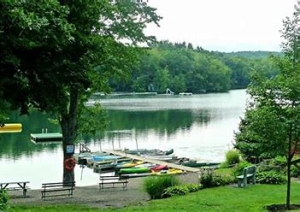
But what is the story of these lakes? How did they come to be? Those are the sort of questions that a geologist loves to answer. The two lakes take us back to the time of the Elizaville Delta. We must imagine the time when the Roe Jan was actively flowing into Glacial Lake Albany. The word “actively” probably does not do justice to what was going on here; enormous amounts of meltwater were raging down the Roe-Jan, and, loaded with dirty sediment, pouring into the lake. Much of that sediment was being added to the growing delta, but there was a problem.

The shoreline area of the lake is likely to have had a lot of floating ice running along it. As sediment was deposited in the lake shore vicinity, a lot of that ice would have come to be buried. Sediment is very good insulation so this buried ice might well have lasted for centuries, but eventually it would melt. As masses of shoreline ice did melt, the sediment above would have collapsed and that would, in each case, leave a large hole. That is what happened at Elizaville, not once but twice.

The result is something called an “ice-cored delta” and these are common in New York State. We frequently find a perfectly good ice age delta with one or, in this case, two holes in it. If the holes are not very deep then they are just swales in the landscape, pretty but not very important. But if they are deep enough then they will fill with water and form lakes or ponds. If they are very big, then people will settle along their shores and maybe put boats into the water. In any event, geologists will always come along and admire these emblems of the Ice age.

Contact the authors at randjtitus@prodigy.net. Join their facebook page “The Catskill Geologist.”
Roeliff Jansen Kill, Part 4 – the delta – 5-19-22

in Uncategorized by

The delta of a river

Stories in Stone

Updated by Robert and Johanna Titus


We continue our journey down the Roeliff Jansen Kill. We began back at Bash Bish Falls and now we have arrived in Elizaville. The kill had been flowing southeast all this distance and had even crossed into Dutchess County. But now, curiously, it has turned sharply to the northwest and is heading towards its destination, a confluence with the Hudson River. But we are going to pause and focus today on the village of Elizaville. There is something special there.

Elizaville lies perched on a bluff that rises above the Kill just to its north. Much of the village is composed of houses built on the shores of the two lakes that are found in the center of the town. They are called, logically enough, “Twin Lakes.”

We have been traveling west on Route 2 and, as we enter Elizaville, we turn right and head north into the village. The road passes between the two lakes and quickly we turn left onto Hapeman Road and head west. Soon it drops down a steep slope, turns left and merges with a Pleasant Vale Road. This part of Hapeman Road has a lot of storytelling to do.


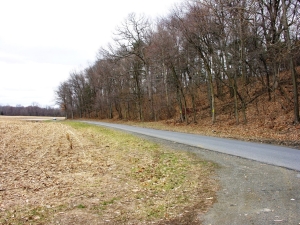
Pull over anywhere along Hapeman, get out and look around. Right along the east side of the road there is a very fine, and very steep slope rising, even towering above the road. Elizaville is built upon the bluff that is defined by the top of that slope. Almost all Hudson Valley geologists would recognize this feature; it is an ice age delta. Back at the close of the Ice Age, just after the glaciers had melted north and the valley was opening up again, something happened. A vast lake was left behind by the retreating glacier. There was, of course, a lot of meltwater, but there was something else. The crust of the earth here had been pressed down by the weight of the ice.

Off, a hundred miles or so to the south, the crust had already rebounded from a similar compression. But here in Elizaville the crust was still depressed. That meant that there was a basin just behind the retreating glacier, and that basin was filled with meltwater which formed what is known as Glacial Lake Albany. The Roeliff Jansen Kill would flow into Lake Albany. Today’s Elizaville marked the end of the river back then. Like any river flowing into any body of water, the Roeliff Jansen Kill would deposit the sediments of a delta.

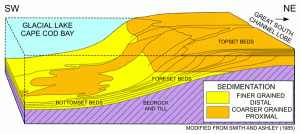
Deltas form all over the world. They form where great rivers flow into oceans or where small brooks flow into ponds. They can be very large or very small. And it really doesn’t matter; in the end they all have the same morphology, or geomorphology if you prefer. All deltas are composed of sediment which has piled up to about the level of the waters. A very large delta will see sediments rise to just above water level. Thus is formed a broad flat surface called, by geomorphologists, a “topset.” Most of Louisiana is topset and so too is most of Bangladesh. Both regions are flat and rise just barely above sea level. The village of Elizaville is perched upon the topset of the Elizaville Delta.

Beyond the topset all deltas display steep slopes. Sediment, which had been carried across the topset, came to the outer edge, and tumbled down a slope. That’s how the foreset slope came into existence. Over time, the foreset will accumulate more and more sediment and advance towards the center of the lake. That makes the delta larger. The steep slope along Hapeman Road is the foreset of the Elizaville Delta.

Beyond the foreset you enter the broad flat deeps of the lake or sea, and that is what we see at Elizaville. West of, and across the Hapeman Road is a flat landscape; it is the old floor of Glacial Lake Albany. The top of the delta is at about 280 feet, while Hapeman bottoms out at 220 feet. The lake was thus 60 feet deep.

Once, Hapeman Street marked the end of the Roeliff Jansen Kill, but that is not the case anymore, our journey is not yet complete.

Contact the authors at randjtitus@prodigy.net. Join their facebook page “The Catskill Geologist.”
Roeliff Jansen Kill – Part three – the Taconic Hills 5-12-22

in Uncategorized by

“Old Man River”

Stories in Stone

Updated by Robert and Johanna Titus


We have been traveling down the length of the Roeliff Jansen Kill and we would like to continue on the third episode of this journey. Last time we explored the “drowned lands” of the Copake region. There we “saw” the Roeliff Jansen drainage basin as it was when ice age meltwater had drowned much of it. Now we continue our journey west and downstream as we pass through into the Taconic Mountains. These aren’t actually much more than hills, but they do exert a profound effect upon the very nature of the Roeliff Jansen Kill.

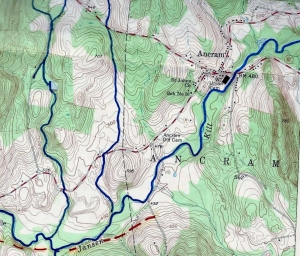
This week’s journey begins at the village of Ancram and finds us heading west on Route 7. We have left the swamps and marshes of the drowned lands behind, and what we see is something that is a much more conventional river valley. We are driving west through Gallatinville, and Spalding Furnace, two old towns with a lot of history. It’s a pretty landscape and it is easy not to notice the geological details. But there are things that we hope you will take note of.

At Ancram itself you will see bedrock in the stream. In fact, there is a pretty good ledge of it. That’s something we have not seen so far on our explorations of the Roeliff Jansen Kill. Back at the drowned lands we saw nothing in the way of bedrock. The whole upper part of the drainage basin is blanketed in ice age sediments. Much of it is sand and gravel, a lot of it is probably ice age lake sediment.

But from Ancram on west to Elizaville we will see, here and there along the stream banks, a number of nice ledges of bedrock. Sometimes you can see glimpses of the river from the highway, and you will look down into something of a bedrock canyon. At other times you will have to make a left turn and follow a side road down to the Roe-Jan. There you are, again, likely to be rewarded with another nice view of a bedrock.

These are the Taconic Hills, and they are made of very old units of rock. In our minds eyes we can travel to shallow and deep-water oceans that existed here hundreds of millions of years ago. Those ancient oceans accumulated masses of sediments which have, since then, hardened into rock. Mountain building events, which occurred 450, 375 and about 250 millions of years ago, have lifted these deposits to their current elevations.

We don’t know when the Roeliff Jansen Kill was first established, but it was likely a very long time ago. All rivers patiently erode away at the landscapes beneath them, and our Roe-Jan is no exception. And that gets us to the most important part of this column. This stretch of the stream is very, very old, many millions of years at the least.

Look left and right and, when the view is a good one, you will appreciate that a lot of erosion went into the creation of the valley here. And that erosion took a very long amount of time. Here is our hypothesis for this part of the river: Erosion of the valley between Ancram and Elizaville began millions and millions of years ago. During that long stretch of time the valley reached pretty much its present size and depth. Then, during the Ice Age, the whole region was buried in glaciers. After these glaciers melted the Roeliff Jansen Kill found its way back into its old channel. Back upstream, glacial sediments clogged the old valley, and the drowned lands came to be formed.

We are not yet done. Route 7 meets an intersection with Rt. 2, and you should follow Rt. 2 toward Elizaville. It seemed to us that the canyon grew deeper as we headed west. There were some very good bedrock exposures along the highway too. At Elizaville this stretch of the Roeliff Jansen Kill comes to an end. We have reached the western edge of the Taconics and are about to leave those hills. We will find a new geological province and see a different stretch of the Roeliff Jansen Kill. But that part of the journey will come next time.

Contact the authors at randjtitus@prodigy.net. Join their facebook page “The Catskill Geologist.”


Roeliff Jansen Kill – Part 2 – the Drowned Lands

in Uncategorized by

The Roe Jan, Part Two: The drowned lands – May 5, 2022

Stories in stone

Updated by Robert and Johanna Titus


Last week we began a journey down the Roeliff Jansen Kill to learn about its geology and its ice age history. We traced the stream back to its origins above Bash Bish Falls and followed it to the village of Copake. We witnessed the melting of glaciers and the tremendous flow of meltwater that once rushed out of the Berkshires and into Columbia County. To see this is a privilege that comes with learning an area’s geology.

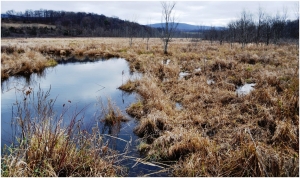
But this time we are going to see a very different sort of Roeliff Jansen Kill. If you look at a map of its drainage basin from Copake to about four miles off to the west, you will find something that we can call the “drowned lands.” At the heart of this region is a parcel of land owned by the Columbia County Land Conservancy. It is officially called the “Drowned Lands Swamp Conservation Area.” This is only part of the total drowned lands which covers much of Copake and most of northeastern Ancram.

The Roeliff Jansen Kill flows through the region. Here the stream’s landscape is entirely different from anything we will see downstream or have seen upstream. The drowned lands are characterized by ponds and small lakes. The largest of these is Copake Lake which you can see, northwest of Copake on Route 7. We counted at least a dozen others; most of them are off the highway and out of sight.

The ponds and lakes are not the most important features in this stretch of the Roeliff Jansen Kill. Far more important are the numerous, and often very large, wetlands. Wander the roads of this area and you will commonly observe swamps, marshes, and bogs, big and small. All this we are, herein, referring to as the drowned lands.

There is a hierarchy of terms that we use to describe types of wetlands. Swamps are just dry enough to support trees and shrubs without drowning them. Marshes are so wet that trees and shrubs are excluded. Bogs are still wetter, and, over time, they accumulate peat deposits. I expect that all three will be found in this region.

But how did the drowned lands come to be? What was their origin? To answer that we have to go back, once again, to the end of the Ice Age. We have seen that vast quantities of meltwater were pouring down through Bash Bish Gorge and flowing out across the lands of Copake. Off to the west, starting in western Ancram, were a series of small hills. These impeded the westward flow of all this water and much of it would be pooled in the area of today’s drowned lands. We like to use the word “puddling” to describe this. Our wetlands are remnants of this ice age history, but there is more.

Along many of the banks of the streams that flow through this area are exposures of fine-grained sand deposits. We would like to spend more time studying these, but we are guessing that they are generally lake sediments and date back to post ice age times.

As you drive this area, try to imagine a few more feet of water covering all of the swampy locations. Go to the Drowned Lands Preserve and see it as a fairly large lake. If you want to, you can add a mastodon or two along the shores!

It would take a lot of very strenuous field work to properly document all of this. A geologist needs to hike about with a soil auger. He will stop here and there and drill holes into the ground to see the extent of the lake deposits. Over time, if he keeps at it, he can construct a map of the old lakes and ponds as they were. We wish we could do this, but we do not have the time.

Still, we are fairly confident of what we are hypothesizing here. We travel the region of the drowned lands, and we look into an ice age past. Then we see a landscape still struggling to overcome the effects of that history. We see Roe Jan drainage which has, even today, not yet developed enough efficiencies to get rid of all the meltwater that has accumulated.

Contact the authors at randjtitus@prodigy.net. Join their facebook page “The Catskill Geologist.”

Go to Top